

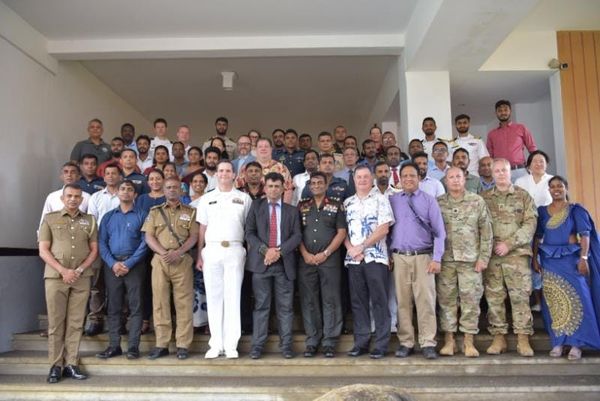
GALLE, Sri Lanka — Disaster-management officials from the United States and Sri Lanka concluded a three-day workshop in the southern coastal city of Galle on Thursday with a simulated emergency exercise aimed at strengthening coordination during major natural disasters and humanitarian crises.
The workshop, held from June 16 to 18, was organized by the U.S. Embassy in Colombo in partnership with the U.S. military’s Center for Excellence in Disaster Management and Humanitarian Assistance, the Montana National Guard, Montana Disaster and Emergency Services, and Sri Lanka’s Disaster Management Centre.
The exercise placed participants in a realistic disaster scenario that required them to coordinate resources, manage public communications, and make critical decisions under pressure, according to the U.S. Embassy. Organizers said the drill incorporated lessons learned from recent disasters, including Cyclone Ditwah.
Officials said the workshop focused on improving interagency coordination, crisis-response planning, and disaster preparedness, while providing an opportunity for Sri Lankan agencies to exchange practical approaches with U.S. emergency-management specialists.
Participants included representatives from the Sri Lanka Army, Navy, Air Force, Coast Guard, and Police, as well as the Department of Civil Security, the Ministry of Defense, the Ministry of Public Security and Parliamentary Affairs, and ministries responsible for health, agriculture, power and energy, the environment, and local government.
The workshop builds on a 2025 memorandum of understanding between Sri Lanka’s Ministry of Defense and the Montana National Guard. The agreement formalized cooperation in disaster response, maritime domain awareness, and professional military education.
The Montana National Guard has been partnered with Sri Lanka since 2021 through the Pentagon’s State Partnership Program, which links U.S. National Guard units with foreign military and civilian agencies. Montana Guard personnel and state emergency-management specialists routinely respond to wildfires, floods, severe winter storms, and other disasters in the western United States.
The exercise took place roughly seven months after Cyclone Ditwah, one of the deadliest weather disasters in Sri Lanka’s recent history. The storm struck the island in late November, triggering widespread flooding and landslides across the country.
According to figures released by Sri Lanka’s Disaster Management Centre, more than 640 people were killed and over 100,000 homes were damaged or destroyed. A World Bank assessment estimated total losses at about $4.1 billion, equivalent to roughly 4 percent of Sri Lanka’s annual economic output.
The disaster also exposed weaknesses in the country’s emergency-response system. Subsequent reviews by researchers and international agencies highlighted shortcomings in early-warning dissemination, interagency coordination, and disaster preparedness, while many rescue efforts in the immediate aftermath were carried out by local communities and volunteers.
Organizers of the Galle workshop said lessons from Cyclone Ditwah informed the exercise, which focused on crisis planning, resource coordination, public communication, and decision-making during rapidly evolving emergencies.
The U.S. Embassy said the program reflected broader efforts to strengthen disaster preparedness and humanitarian cooperation across the Indo-Pacific region, where natural disasters frequently threaten communities, critical infrastructure, and economic activity.