
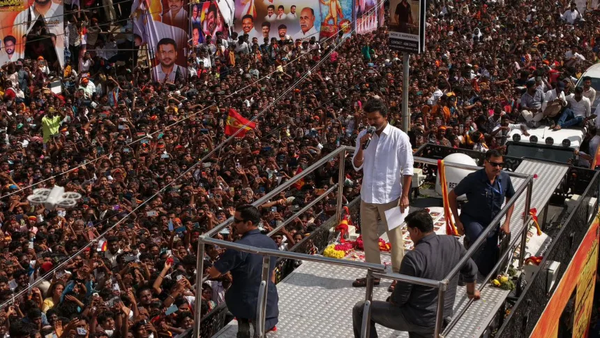
JAFFNA, Sri Lanka — On the eve of a Tamil Nadu election that could reshape the southern Indian state’s political landscape, one of the most closely followed Tamil-language commentators has described the contest as a volatile three-way race with no clear frontrunner, as the entry of actor Vijay’s new party challenges the long-standing dominance of the state’s two Dravidian heavyweights.
The assessment, first aired in a televised interview and later distilled into a social media post by Samas, editor in chief of the Tamil news channel Puthiya Thalaimurai, comes hours before an estimated 63 million voters are set to go to the polls on Thursday to elect all 234 members of the state’s Legislative Assembly. Votes are scheduled to be counted on May 4.
Samas, whose ground-reporting series “Payanangal” tracked electoral trends in Delhi in early 2025 and in Bihar last November, wrote that no single party currently held a decisive advantage and that the election posed risks for all three major formations.
The familiar rivalry between the ruling Dravida Munnetra Kazhagam, led by Chief Minister M. K. Stalin, and the All India Anna Dravida Munnetra Kazhagam, led by former chief minister Edappadi K. Palaniswami, remains at the centre of the contest. The DMK is seeking to retain its advantage after winning 159 seats in 2021, while the AIADMK, which secured 66, has regrouped in opposition and returned to the campaign with renewed momentum.
What has altered the electoral arithmetic, Samas argued, is the emergence of the Tamilaga Vettri Kazhagam, founded in February 2024 by Mr. Vijay, one of Tamil cinema’s biggest box-office figures. The party is contesting all 234 seats independently after ruling out alliances, and has campaigned on promises including a drug-free state, job guarantees for young people, collateral-free education and startup loans, and monthly stipends for students.
Samas described the party as a potential “disrupter,” capable of reshaping entrenched voting patterns. Since Tamil Nadu’s formation as a linguistic state in 1956, he noted, only two parties have secured double-digit vote shares in their debut elections — the DMK in 1957 and the AIADMK in 1977. TVK, he suggested, could approach or exceed that benchmark, and may enter “challenger” territory if it crosses 20 percent of the vote in key constituencies.
Regionally, the analysis points to an advantage for the DMK-led alliance in the Chola and Pandya belts of central and southern Tamil Nadu, while the AIADMK is seen as stronger in the Kongu region in the west. Chennai and the northern districts — the Tondai belt — are described as the most unpredictable battleground, and likely to prove decisive.
Samas also highlighted demographic shifts that established parties may have underestimated. TVK’s appeal, he wrote, extends beyond first-time voters to the broader under-50 electorate, which forms a majority of the state’s roll. Women — whose support has historically anchored the AIADMK and, more recently, the DMK — could emerge as a decisive and increasingly fluid voting bloc.
The rise of a new party, he argued, reflects not only Mr. Vijay’s personal appeal but a deeper public frustration — with unemployment, concerns over law and order, including drug use, and a growing perception of dynastic politics within both Dravidian parties. Mr. Stalin’s son, Udhayanidhi Stalin, serves as deputy chief minister, while the AIADMK has faced internal succession struggles since the death of J. Jayalalithaa in 2016.
At the same time, Samas noted that the DMK retains significant institutional advantages, including welfare and cash-transfer programmes targeting women and students, as well as a political posture toward the Bharatiya Janata Party-led central government that many Tamil voters view as assertive.
“When a new entrant disrupts the field in this manner,” Samas wrote, “it becomes difficult to predict who will fragment and who will consolidate.”
The outcome, he suggested, may hinge less on entrenched loyalties than on how decisively voters choose to break from the past