
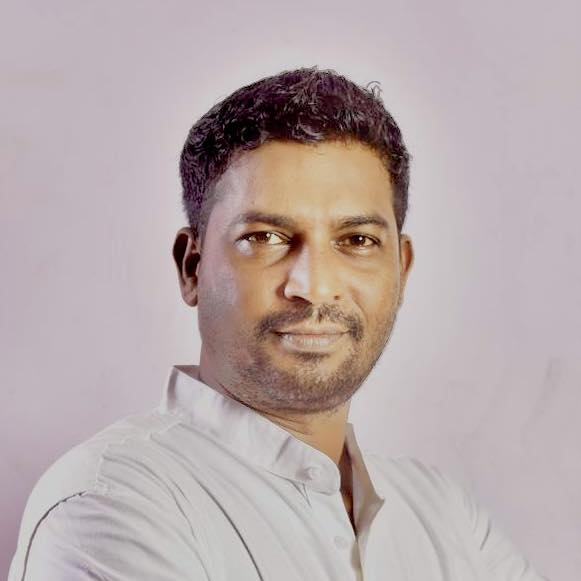
A Jaffna-based civil activist has used Tamil actor Vijay’s landmark electoral victory in Tamil Nadu as a launchpad for a biting satirical open letter that says far more about Sri Lankan Tamil political culture than it does about the film star himself — lampooning dynastic privilege, and caste hierarchy.
Arun Siddharth, Jaffna District Coordinator of Sarvajana Balaya, addressed the letter to Vijay at his party’s Chennai headquarters, opening with a salutation to the “Honorable ‘Excellency’ Commander Albet Chandrasekar Joseph Vijay” — the quotation marks around Excellency doing considerable work. The inflated honorifics parody the militaristic hero worship Siddharth argues has long disfigured Tamil celebrity politics on both sides of the Palk Strait.
After congratulating Vijay on following M.G. Ramachandran’s populist template “without the slightest deviation” to become Chief Minister, the letter pivots sharply. Its stated purpose, Siddharth wrote without embarrassment, is “mainly to create division” regarding two Sri Lankan Tamil politicians who have sent Vijay congratulatory letters of their own: Gajendrakumar Ponnambalam, leader of the Tamil National People’s Front, and Archuna Ramanathan, a sitting parliamentarian. “Do not trust either of them,” he advised.
The indictment of Gajendrakumar rests on several charges. Siddharth noted that the TNPF leader had travelled to Chennai just three or four months earlier to meet Vijay’s political rival M.K. Stalin and deliver a similarly effusive congratulatory letter — at which point he showed no interest in Vijay whatsoever. The dynastic parallel was equally pointed: the Ponnambalam family’s grandfather-to-father-to-grandson political succession, Siddharth wrote, mirrors precisely the hereditary politics Vijay had campaigned against in Tamil Nadu.
Siddharth accused Gajendrakumar and his associates of coaching Seeman, the leader of Naam Tamilar Katchi. The result, he suggested, was Seeman failing to win a single seat. “Whoever they associate with ends in defeat,” Siddharth wrote, invoking a Tamil proverb about a tortoise entering a house.
Archuna Ramanathan fared no better. Siddharth described him as a man who once raised a gun in a land dispute and threatened a woman, an incident he said left the parliamentarian politically “crippled.” He added that Ramanathan creates chaos wherever he goes and is widely regarded in Jaffna as mentally unstable. The warning to Vijay was blunt: maintain no connection with either man.
Caste runs through the letter as its deepest preoccupation. Siddharth framed both politicians as products of dominant-caste privilege. One, he wrote, boasts that his family once owned 160 buses and claims the entire Sri Lanka CTB fleet as its legacy; the other has investments in a money-lending finance company. One has stated on video that he is a “Vellala” man — a reference to Jaffna’s historically dominant caste. Siddharth also wrote that he possesses videos of both men verbally abusing their own mothers. “These are people with arrogant caste mentality,” he wrote. “Now they may even begin subtly investigating what caste Vijay belongs to.”
Against this, Siddharth drew an unlikely bond of shared identity between himself and Vijay. Both, he noted, display portraits of Ambedkar and Periyar on their walls. His own son, named Siddharth Maitreyan after the Buddha, has the religion field left blank on his birth certificate — a gesture Siddharth said he had heard Vijay’s father also made for Vijay. Siddharth further noted that his wife’s family converted to Christianity after her father was taken and shot by the LTTE in 1990, while also emphasizing that Vijay himself is a Christian.
The letter’s most theatrical proposal came near its close: that Vijay register a Sri Lankan branch of his Tamilaga Vettri Kazhagam, humorously suggesting that simply replacing “Tamilaga” with “Tamil Eelam” would create a “Tamil Eelam Vettri Kazhagam” powerful enough to shake Sri Lanka’s political establishment. Siddharth argued, partly in jest, that the name alone would sound “electrifying” and could help send the island’s hereditary politicians home. He further claimed that many young Sri Lankans had already celebrated Vijay’s victory with fireworks, adding that many of those enthusiastic supporters were his own friends.
The letter ended with a personal wager. Siddharth’s twelve-year-old son, a devoted Vijay supporter, had challenged his father to a bet on the election outcome: if Vijay won, Siddharth would shave his head bald; if Stalin won, the boy would obey his father for a month. “Now I am in a position where I must shave my head,” Siddharth conceded.
The postscript was in keeping with the letter’s register throughout. Should Vijay wish to call, Siddharth wrote, he stood ready to travel to Chennai in person to “create further division” by providing detailed accounts of other figures as well. He signed off as “Future Member of Sri Lankan Parliament in 2029.”