

“AKD Walked the Same Road”: Jaffna Protesters Reject Security Justification for Land Occupation

“AKD Walked the Same Road”: Jaffna Protesters Reject Security Justification for Land Occupation


Share this post

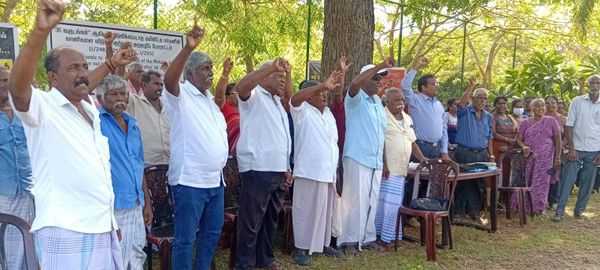
MAYILIDDY, Sri Lanka — The chairman of a local government body in Sri Lanka's Northern Province said Sunday that there was "absolutely no justification" for the military to continue occupying civilian lands in the region, speaking at a protest demanding the return of privately owned property still under military control more than a decade and a half after the end of the country's civil war.

The demonstration, organized by the Valikamam North Resettlement Development Committee, drew residents from four Grama Sevaka divisions in the Valikamam North area who say they have been unable to reclaim lands seized during the conflict between government forces and the Liberation Tigers of Tamil Eelam, which ended in 2009. Organizers say roughly 3,000 acres remain under military control in the area.

Thiyagarajah Nirosh, chairman of the Valikamam East Pradeshiya Sabha, accused successive governments of failing to return the land and alleged that displaced families continued to live without permanent housing while the military used portions of the occupied property for agriculture and other activities.

"For 37 years, the state has held these lands at gunpoint," Mr. Nirosh said. "Even 17 years after the war, our people are still fighting for the return of their own lands."

He described the continued occupation as "an ethnic-driven project" and called on the government to immediately release the lands and compensate residents for decades of military use.

Mr. Nirosh also pointed to a recent visit by President Anura Kumara Dissanayake to Jaffna as evidence that no genuine security rationale existed for maintaining the military presence.

"When the President visited Jaffna recently, he walked alone on this very road," he said. "That itself shows there is no security threat here."

Land occupation by the military has remained one of the most contentious post-war issues in Sri Lanka's Northern Province, where Tamil residents and civil society organizations have for years demanded the release of property acquired during the conflict.


Share this post

Be the first to know

Join our community and get notified about upcoming stories

Subscribing...
You've been subscribed!
Something went wrong
The Real Battle for Credibility

The Real Battle for Credibility

This month, I was invited to speak at the second Sri Lanka–India Media Friendship Association (SLIMFA) Media Fest in Colombo, on the theme “Trust, Truth and the Battle for Credibility.” Illness prevented me from attending. I have chosen instead to publish the thoughts I had prepared as this month’s editorial, because the issues they address extend far beyond a conference hall. Where I Stand I come from Northern Sri Lanka, a region devastated by nearly three decades of civil war. My entire chi


Aruliniyan Mahalingam

Aruliniyan Mahalingam

Rights Group Accuses Sri Lanka of Obstructing Chemmani Mass Grave Investigation

Rights Group Accuses Sri Lanka of Obstructing Chemmani Mass Grave Investigation

For three decades, the state’s answer to the families of Jaffna’s disappeared has been that it does not know. A report released this week argues that it has always known — and has spent thirty years making sure that nothing could be done about it. The report, published by the International Truth and Justice Project (ITJP), a London-based group that has documented Sri Lankan war crimes since 2013, lands as excavators returned to the Chemmani salt flats on Tuesday to resume a dig that has already


Our Reporter

Our Reporter

Should Sanctions Extend to a General's Memoir?

Should Sanctions Extend to a General's Memoir?

By M.R. Narayan Swamy Realising that the war for Tamil Eelam would need a constant supply of weapons, Velupillai Prabhakaran set up in 1985 Kadal Pura, a modest sea wing in the Liberation Tigers of Tamil Eelam (LTTE). Over the years, it grew into the formidable Sea Tigers, which threatened to overwhelm Sri Lanka’s navy. Once the fourth and final Eelam War resumed in August 2006, it became payback time. The Sri Lankan Navy rapidly sank in 2007 the LTTE’s awesome warehouse ships, left and right.


M.R. Narayan Swamy

M.R. Narayan Swamy

The Missing Half of Sri Lanka's Post-War Recovery

The Missing Half of Sri Lanka's Post-War Recovery

By Jeevan Thiagarajah Seventeen years after Sri Lanka's civil war ended, the country has run one of the world's more closely studied reintegration experiments — and left another almost entirely undone. On one side, 12,196 former LTTE combatants passed through a state-run rehabilitation programme that concluded in 2021. On the other, hundreds of thousands of state security personnel — soldiers, sailors, airmen, and police who fought the same war — returned home to no equivalent programme at all.


Jeevan Thiyagaraja

Jeevan Thiyagaraja