
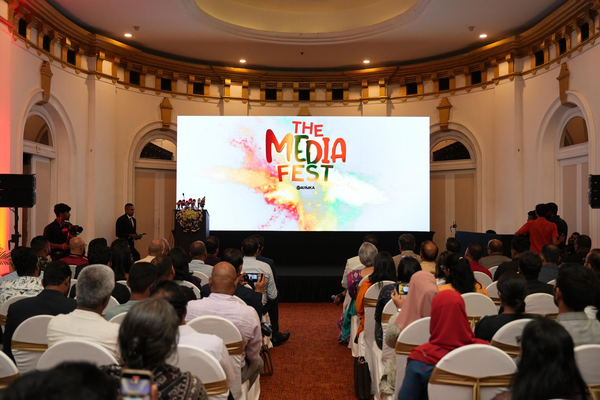
This month, I was invited to speak at the second Sri Lanka–India Media Friendship Association (SLIMFA) Media Fest in Colombo, on the theme “Trust, Truth and the Battle for Credibility.” Illness prevented me from attending. I have chosen instead to publish the thoughts I had prepared as this month’s editorial, because the issues they address extend far beyond a conference hall.
Where I Stand
I come from Northern Sri Lanka, a region devastated by nearly three decades of civil war. My entire childhood and adolescence were lived inside that conflict.
For those of us in the North, and, I believe, for many in the East, misinformation and disinformation are not new. They did not arrive with social media, artificial intelligence, or the digital age. They were woven into the media environment in which we grew up. People understood that much of what they read, heard, and watched was shaped by political interests, competing narratives, and wartime agendas. Misinformation was not an exception. It was part of the game.
Let me say something uncomfortable. The war left many people in Northern Sri Lanka with so little faith in mainstream media that they approach it with the same scepticism they reserve for rumour-driven Tamil websites, Facebook pages, TikTok videos, and YouTube channels.
Why?
Because we grew up watching the same event presented in entirely different ways by the two warring parties — the Sri Lankan state and the LTTE. Each promoted its own version of reality.
Consider one example from my childhood. During Operation Leap Forward, the military offensive on the Jaffna peninsula, the Sri Lanka Air Force bombed the Church of Saints Peter and Paul in Navaly, where hundreds of civilians had sought shelter. About 150 people were killed.
That night, state radio announced that the Air Force had successfully attacked an LTTE camp in Navaly and killed scores of terrorists. The next morning, Tamil newspapers carried photographs of bodies inside a church and reports that civilians, not fighters, had died.
It would be tempting to conclude that the Tamil press stood on the side of truth. In that instance, it did.
But that was only part of the story. Those same newspapers could not publish, or even whisper, anything critical of the LTTE. The organisation exercised overwhelming, if not total, control, and journalists were largely at its mercy.
Take another example. In 2004, when the LTTE’s Eastern commander, Karuna, broke away, it marked the beginning of one of the movement’s most consequential ruptures. Yet most Tamil newspapers remained silent. Many people in Jaffna were barely aware that the LTTE was facing a profound internal crisis. I still remember watching Sun TV report the split from Tamil Nadu while newspapers in Northern Sri Lanka made no mention of it.
The silence was born of fear. Like the Sri Lankan state, the LTTE showed little tolerance for dissent. Journalists did not have to become outspoken critics to place themselves at risk. The slightest departure from the approved narrative could carry deadly consequences.
That fear was real. But the resulting silence was more than an absence of information. It was a form of misinformation in itself.
I write, then, for my generation — the children of the 1990s — and for the one before us, the children of the 1980s. For us, believing the news as it was presented was never simple. Too often, what we read or heard contradicted what we had seen with our own eyes, or what plain common sense told us.
That scepticism has been handed down to a generation that never lived through the war.
I still remember a report in a leading Tamil newspaper, published years after the fighting ended. The story was simple: a man had died in a motorcycle accident. But the report did not stop there. It added that the victim’s uncle had once been a notorious member of a paramilitary group. The detail had no bearing whatsoever on the accident. Its only purpose, it seemed, was to suggest that the man’s death was some karmic settling of accounts for his uncle’s past.
My Greatest Challenge
Today, as the editor of an English publication based in Northern Sri Lanka, my greatest challenge is not confronting misinformation or disinformation. It is rebuilding trust in journalism itself.
The tools have changed. Algorithms, deepfakes, and artificial intelligence have transformed how falsehoods are created and spread. But the underlying problem is much the same. People have learned, often through painful experience, that neither official narratives nor viral content can be accepted at face value.
Every day, we try to persuade our readers that journalism can be independent, impartial, and grounded in evidence — that news can simply report what happened, without serving a political or ideological agenda. Even that is difficult.
That is why the challenge looks different here. In many places, the battle for credibility is about exposing falsehoods. In the North and East, it is also about restoring faith in the possibility of objective journalism.
Silence
There is another threat to truthful journalism, one that receives far less attention.
It is silence.
In my region, many journalists worry less about spotting misinformation than about what might happen if they publish a story that draws the establishment’s attention.
To understand how widely this concern is shared, I recently called ten Tamil journalists from the North and East and asked each of them a single question: What worries you more, misinformation and disinformation, or the consequences of reporting the truth?
Seven gave the same answer. They feared the consequences of reporting the truth.
The war ended seventeen years ago. Journalists are no longer killed on the roads like dogs, as they once were. But many of the structures that presided over that era remain, and the memory of what happened to those who reported the truth has not faded.
Self-censorship has settled deep into our journalistic culture. The question my colleagues ask is often not “Is this true?” but “Is this safe to publish?”
That is why silence deserves as much of our attention as misinformation. The public is not only misled by what is falsely reported. It is misled, just as surely, by what is never reported at all. And a press that is not free to report cannot, in the end, be a press its readers trust.
The Phone Call
The security forces and intelligence agencies in the North and East do not merely monitor Tamil journalists. At times, they seek to use them as sources.
Cover a public meeting in Jaffna, Kilinochchi, Vavuniya, or elsewhere in the region, and a phone call may follow. Who organised the event? Who funded it? Who attended? Who spoke? Journalists are asked to hand over photographs, video footage, and the names of those present.
Many do not want to comply. But fear is real. These institutions still wield significant power, and their history casts a long shadow. It does not have to be spoken aloud to be understood.
This is where credibility suffers its deepest damage. A journalist known, or even suspected, to be passing information to the intelligence services, whether out of fear or coercion, will struggle to earn the trust of the community. And when people no longer trust journalists, they stop talking to them. The loss is not only for the press. It is the public’s right to know.
I should add that I have not experienced this personally, as I no longer work as a field reporter. It is a reality described to me, independently and repeatedly, by colleagues who continue to report on the ground.
Where the Lines Blur
Not every threat to our credibility comes from the state.
In parts of the North and East, it is no longer unusual for people with open political affiliations to register themselves as journalists. In one case, a politically affiliated individual launched a news website, registered as a journalist, joined the Vavuniya Press Club, and went on to serve first as its secretary and then as its president. The press club is now defunct. Similar patterns can be seen across almost all Tamil-speaking areas of Sri Lanka.
Economics is another driver. One district correspondent for a leading Tamil newspaper recently told me he earned Rs. 2,500 for an entire month’s work. At some Tamil newspapers, reporters are still paid under the old “foot-ruler” system. Once an article appears in print, its length is measured with a ruler, and payment is calculated by the column inches it occupies rather than by its quality, importance, or impact.
It is difficult to expect independent, courageous journalism from reporters paid so little they can barely survive. Low wages leave them exposed to political influence, patronage, and self-censorship.
Where Do We Go From Here?
Technology can help journalism, but it cannot save it. Artificial intelligence, fact-checking tools, and other innovations can expose falsehoods, speed up verification, and strengthen reporting. But the foundation of public trust lies in the independence, integrity, and courage of journalists.
Some of these battles cannot be won by journalists alone. We cannot erase decades of fear, nor transform the standards of a profession overnight. That requires change across the profession, its institutions, and the society it serves. What a newsroom can control is its own conduct.
At Jaffna Monitor, we have adopted a simple philosophy: we tell our readers that we are human too. We rigorously investigate and carefully verify, but we are not infallible. When we make a mistake, we acknowledge it openly, correct it transparently, and explain what happened. Admitting an error does not diminish credibility. Refusing to acknowledge one does.
We also try not to preach. We do not stand above our readers. If anything, we assume they are as informed and as intelligent as we are, and often more so.
That is why we try to remain open to criticism. We publish articles and letters to the editor that challenge Jaffna Monitor. A newspaper that holds others to account must be willing to be held to account itself. A newsroom that invites scrutiny will earn more credibility than one that insists it is never wrong.
Media houses and journalists often ask, “How do we make people trust us?” That is the wrong question. The better question is: what makes us worthy of that trust?
Trust is not built through branding, or by claiming to be right all the time. It is earned by being transparent, by welcoming scrutiny, and by being accountable to the people we serve. That means showing our evidence wherever possible, distinguishing clearly between fact and interpretation, correcting our mistakes, and being honest about what we know, what we do not know, and what cannot yet be verified.
It also means applying the same standards to everyone. If we investigate the government, we must be equally willing to scrutinise our own communities, our political movements, and those with whom we sympathise.
Journalism also requires humility. There is integrity in saying, “We do not know yet.” Journalism is not the business of certainty; it is the disciplined pursuit of evidence.
There is reason for hope. Research by the Reuters Institute has found that when people encounter information they suspect may be false, they still turn to trusted news organisations more often than to fact-checking websites. The public has not abandoned journalism. It is still searching for institutions worthy of its trust.
Journalism is often described as a search for truth. In the North and East of Sri Lanka, it has become something more fundamental. Before we can persuade people to believe the truth, we must first persuade them that truth can still be found — and that independent journalism is capable of finding it.
That is the real battle for credibility.
With love,
Aruliniyan Mahalingam