

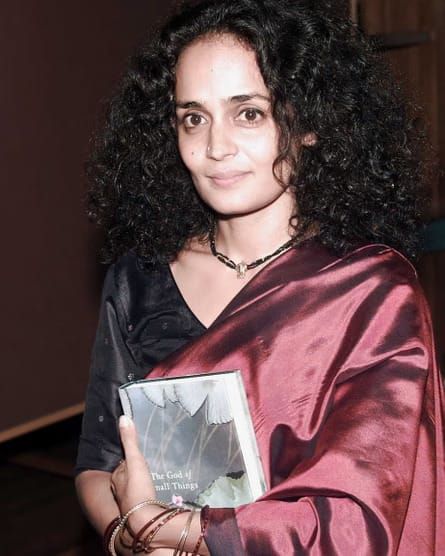
Arundhati Roy Says Gaza Echoes Sri Lanka’s Final War

Arundhati Roy Says Gaza Echoes Sri Lanka’s Final War


Share this post

Booker Prize–winning author and political activist Arundhati Roy has drawn direct parallels between the Israeli assault on Gaza, which has since come to a ceasefire, and Sri Lanka’s military offensive  in 2009, describing both as examples of unchecked, state-led massacres that have reshaped the global standard for impunity.

In a wide-ranging interview with journalist Mehdi Hasan, Roy described the carnage in Gaza as "a genocide unfolding before us, in a way that has never been so visible to the world."

"What is worrying," Roy said, "is that all these big, great leaders are watching what Netanyahu can get away with in Gaza — and that is the bar that is being set. At one point, it was what happened in Sri Lanka. Now, it's Gaza." Roy made the remarks during the height of the Gaza war, before the current ceasefire took effect.

Her remarks recall the 2009 Mullivaikkal massacre, when tens of thousands of Tamil civilians were killed during the final phase of Sri Lanka’s civil war. The United Nations and multiple international investigations have since documented evidence of indiscriminate shelling of hospitals, starvation blockades, and the execution of surrendering civilians by Sri Lankan forces. These investigations also recorded war crimes committed by the LTTE, including the use of civilians as human shields, the shooting of those attempting to flee LTTE-controlled areas, and the forcible conscription of children through its abduction squads.

Roy's comparison underscores how Sri Lanka's final offensive — once cited by Western and regional powers as a counter-terrorism "success story" — has now become a benchmark for modern impunity in global conflicts.

"At that time," Roy noted, "world powers either looked away or quietly celebrated Colombo's 'decisive victory.' What we're seeing now in Gaza is not just history repeating itself — it's the normalization of mass atrocity."

Arundhati Roy won the Booker Prize in 1997 for The God of Small Things.


Share this post

Be the first to know

Join our community and get notified about upcoming stories

Subscribing...
You've been subscribed!
Something went wrong
Why Tamil Politics Cannot Be a Pensioner's Hobby
A cut-out portrait of Judge M. Ilancheliyan from his farewell ceremony.

Why Tamil Politics Cannot Be a Pensioner's Hobby

If you trace the arc of Tamil political leadership from Independence to today, one pattern repeats with stubborn persistence: our fate has been decided almost exclusively by lawyers. From Sir Ponnambalam Ramanathan and G.G. Ponnambalam to Thanthai Chelva and Amirthalingam, and now to Sumanthiran and Gajendrakumar—the legal profession has monopolized Tamil political space for more than a century. Nothing personal against lawyers. But their craft is built on argument, narrative construction, and


Kaniyan Pungundran

Kaniyan Pungundran

Jaffna Swami
Picture produced using GPT-4 https://chat.openai.com

Jaffna Swami

Translated from the original Tamil short story yāḻppānaccāmi  (யாழ்ப்பாணச் சாமி)  by Shobasakthi. The original story is available at his website. If you have any questions or feedback, please contact ez.iniyavan@gmail.com. This story is not about the Aruḷampalam Swami who was immortalized in song by the great Tamil poet Bharathiyār, calling him the eye of the world and the enlightened vessel that delivers sinners from their suffering. I am about to tell you the story of a different Jaffna Swami


Eḻuttukkiṉiyavaṉ

Eḻuttukkiṉiyavaṉ

WE ARE SORRY

WE ARE SORRY

Editorial Thirty-Five Years of Silence, Thirty-Five Years of Shame On October 30, 1990 — thirty-five years ago — the Liberation Tigers of Tamil Eelam, with we Tamils as mute spectators, committed an atrocity that erased whatever moral or ethical ground our struggle once stood upon. In an orchestrated act of ethnic cleansing — not in scale, but in spirit comparable to the mass expulsion of the Rohingya from Myanmar; reminiscent of the 1948 Palestinian Nakba; echoing the forced displacement of


Kaniyan Pungundran

Kaniyan Pungundran

No Minority Politician Can Solve Ethnic Issues Without the Trust of the Majority: Faiszer Musthapha
Faiszer Musthapha

No Minority Politician Can Solve Ethnic Issues Without the Trust of the Majority: Faiszer Musthapha

At Jaffna Monitor, we believe that meaningful conversations about ethnic representation, national unity, and pluralistic governance are essential for Sri Lanka’s democratic future. For decades, ethnic politics has shaped — and often fractured — the country’s political landscape and the fate of its people. Yet critical questions remain unanswered: What is the most effective path for minority communities to secure their rights and interests? Should minority leaders work within majority-led nationa


Jaffna Monitor

Jaffna Monitor