

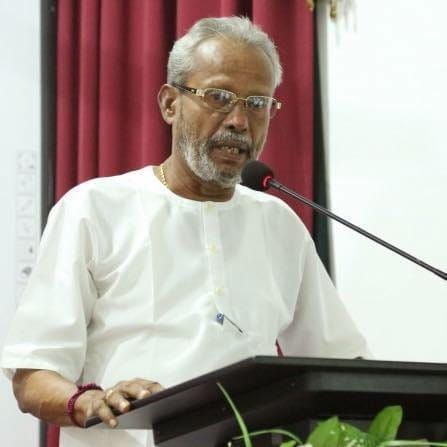
Except Cycle Party, We All Are United, C.V.K. Sivagnanam Tells India

Except Cycle Party, We All Are United, C.V.K. Sivagnanam Tells India


Share this post

Acting leader of the Ilankai Tamil Arasu Katchi (ITAK), C.V.K. Sivagnanam, has voiced frustration over India’s repeated calls for Tamil political unity, insisting that all major Tamil parties — except for the Tamil National People’s Front (TNPF), widely known as the Cycle Party — are already united in their demand for the full implementation of the 13th Amendment to the Constitution.

Speaking to the media, Sivagnanam questioned the rationale behind New Delhi’s constant reminders.

“On the matter of implementing the 13th Amendment that already exists in the Constitution, except for the ‘Cycle Party,’ all of us are united. Then why does the Indian side keep telling us again and again: ‘Unite, unite’? They cannot say we are not united, especially knowing full well that the ‘Cycle Party’ will not come along,” he said.

Sivagnanam said that even during ITAK’s recent meeting with the Indian High Commissioner to Sri Lanka, the envoy repeatedly emphasized the need for Tamil parties to “come together.”

“The truth is, we are already united. For example, in demanding the full implementation of the 13th Amendment, we stand together. There is no such thing as perfect unanimity anywhere in the world,” he observed.

Not the Final Solution

Sivagnanam emphasized that while the 13th Amendment does not represent the ultimate solution to the Tamil national question, its implementation remains a constitutional obligation that cannot be postponed.

"We are asking that the 13th Amendment be implemented, but at the same time, we are also saying it is not our ultimate solution," he clarified. "Even now, we continue to emphasize that the 13th Amendment is not the solution for us."

However, since the amendment is already enshrined in the Constitution, the government must act without delay, he added.

India's Responsibility

The ITAK leader also reminded India of its moral and political obligations under the Indo–Sri Lanka Accord of 1987, which established the framework for the 13th Amendment and provincial devolution of power.

"Even though we say the international community must show greater concern over the Tamil issue, the primary responsibility lies with India," Sivagnanam stated. "Through the Indo–Sri Lanka Accord, that responsibility is clearly with India. We have placed great trust in India."

He concluded with a direct appeal to New Delhi: "The power and strength to bring about this change rest with India. We believe in that, we expect India to act, and we urge India to act."

The 13th Amendment, introduced following the Indo-Sri Lanka Accord, provides for provincial councils with devolved powers. However, its full implementation has remained contentious, with successive Sri Lankan governments either reluctant or unable to devolve all promised powers to the provinces.


Share this post

Be the first to know

Join our community and get notified about upcoming stories

Subscribing...
You've been subscribed!
Something went wrong
After Assurances, Thaiyiddy Landowners Agree to Survey in Temple Dispute

After Assurances, Thaiyiddy Landowners Agree to Survey in Temple Dispute

THAIYIDDY, Sri Lanka — For more than three decades, Sarujan Sukumari and many others were unable to set foot on their family lands. Seized by the military and designated a High Security Zone, the area remained inaccessible even after the war ended in 2009. Years later, as the country settled into an uneasy peace, a Buddhist temple rose on what had once been their ancestral property. Recently, she and other landowners sat in a government conference room in Jaffna as a cabinet minister and senio


Our Reporter

Our Reporter

The War That Reopened What Was Already Open

The War That Reopened What Was Already Open

By Abbi Kanthasamy The real winners of this war were not the Iranian people, not the Lebanese, not the Gulf Arabs, not the Americans, and certainly not the poor fools told to clap every time a missile takes off on television. The winners were the people who always win. The weapons manufacturers. The oil traders. The consultants in expensive suits using phrases like maritime de-risking and regional deterrence posture. The lobbyists. The think-tank parasites. The men who can turn blood into bil


Abbi Kanthasamy

Abbi Kanthasamy

A Tale of Two Energy Landscapes: Trincomalee Oil Tanks and Jurong Island

A Tale of Two Energy Landscapes: Trincomalee Oil Tanks and Jurong Island

By: Dr. Gamini Goonetilleke The contrasting stories of the oil tank farm in Trincomalee and the development of Jurong Island, located to the southwest of mainland Singapore, provide a powerful example of how vision, planning, and governance can shape the destiny of strategic assets. Both locations possess significant geographical advantages and lie along major maritime routes. Yet, while Jurong Island has grown into a global energy and petrochemical hub, the Trincomalee oil tanks have r


Dr. Gamini Goonetilleke

Dr. Gamini Goonetilleke

The Batalanda Report Was Tabled. A Year Later, Justice Was Not

The Batalanda Report Was Tabled. A Year Later, Justice Was Not

COLOMBO — One year after Sri Lanka’s Attorney General received the Batalanda Commission report — detailing torture chambers, extrajudicial killings and enforced disappearances during the government’s suppression of the Janatha Vimukthi Peramuna (JVP) insurrection — no one has been charged, no prosecutorial update has been issued, and the parliamentary debate that was promised has yet to be scheduled. The silence that has followed, political analysts say, reflects not only legal complexity but a


Our Special Correspondent

Our Special Correspondent