The photographs were clearly intended to project an image of simplicity. There was the President, the Prime Minister, and cabinet ministers — seated on ordinary plastic chairs, eating from simple plates like ordinary citizens at an almsgiving ceremony hosted by a senior government minister at his residence in Kaduwela.
The images circulated widely on social media, amplified by the ruling National People's Power party's supporters. For a moment, they achieved their intended effect, drawing admiration for the government's apparent humility. "You might think at first glance that these are just villagers," read one widely circulated post, "but they are the President and the Prime Minister."
Within hours, however, the conversation turned. The public's attention shifted — not to the modesty of the guests, but to the scale of their host's home.
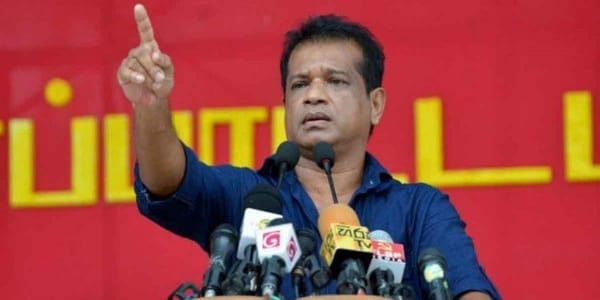
The host is Agriculture Minister K.D. Lal Kantha: a veteran Janatha Vimukthi Peramuna organiser who spent decades in full-time politics without private-sector employment, was arrested and tortured during the 1987–89 insurrection, escaped from a detention camp, and built his political identity around the image of the committed, self-sacrificing revolutionary. He is a Politburo member and the JVP's Administrative Secretary — one of the party's most senior figures. His official parliamentary address is listed not as a private residence but as the JVP headquarters in Pelawatta, Battaramulla.
His three-storey Kaduwela home — fitted with air-conditioning, solar panels, a piano and high-end furnishings — has since triggered formal complaints to the country's anti-bribery commission, a police hotline report, and a question that now sits uncomfortably at the heart of the NPP's governing identity: how did one of its most prominent ministers, a lifelong political worker with no known private income, finance such a residence?
'Social Capital'
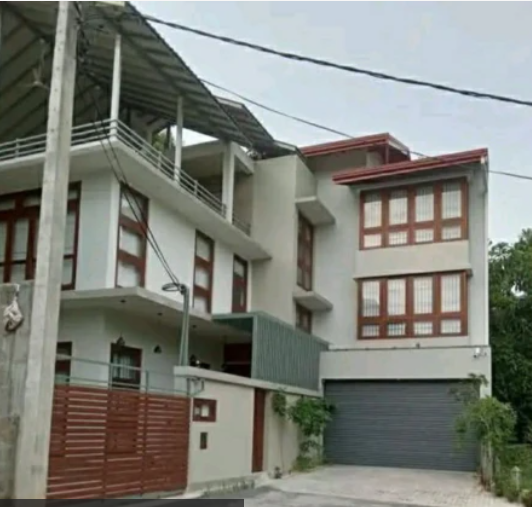
The minister's explanation, offered in a YouTube interview, rests on several pillars. He said the house was built by combining two plots of land — totalling thirteen perches, he maintains, though critics claim thirty — purchased using proceeds from the sale of a family property near Kandy Road at Matale Junction. His wife's employment covered household expenses during years when he drew no salary. He moved into the finished house in late 2024, he said, and the gathering that ignited the controversy was not a housewarming but an almsgiving organised in memory of his deceased parents.
On the piano — which had become, in social media discussions, a particular symbol of perceived hypocrisy for a party that has long presented itself as the voice of the underprivileged — he offered a mundane explanation: his daughter had been studying music since childhood, and the instrument had been in the family for fifteen years. "Having a set of chairs in a house nowadays is not a magic trick," he added.
He also offered a defence of his evolving lifestyle that broke with JVP orthodoxy. Capitalism, he argued, was defined not by the consumption of goods but by the ownership of capital and the exploitation of labour. Living standards change as society changes, he said, and it is natural for them to rise.
But it was his invocation of "social capital" that most consequentially changed the terms of the debate. He described having accumulated, over nearly four decades in politics, a network of trusted associates across the country — in Kandy, Anuradhapura, Colombo and elsewhere — who would give him money on nothing more than a telephone call, with no expectation of return. If necessary, he said, he could raise Rs. 500,000 each from one hundred such people within a single week. "That is Rs. 50 million," he said, "and many people do not know how to measure that kind of value."
A Defence That Contradicts Itself
The government’s response has done little to clarify matters. Defending the Agriculture Minister on April 7, Foreign Minister Vijitha Herath said, “Minister Lal Kantha built his house before he became a minister. He financed it by selling his properties in Anuradhapura and his wife’s properties in Kandy.” He also urged journalists with concerns about ministers’ assets to file complaints with the Bribery Commission.
Key details remain undisclosed. The total construction cost of the house has not been revealed, nor has the sale price of the ancestral property. The nature and extent of the minister’s wife’s income have also not been specified.
Whether the Kaduwela property is listed in the minister’s annual asset and liability declarations to the Commission to Investigate Allegations of Bribery or Corruption (CIABOC) remains unclear.
The minister has confirmed that his 2025 declaration was submitted, and CIABOC officials have acknowledged receiving it. However, the document has not been made public, and no explanation has been provided for the delay.
This is not Lal Kantha’s first encounter with such questions. In September 2025, responding to Deputy Minister Nalin Hewage’s remark that people with money are thieves, Lal Kantha made a striking declaration: “I have been asked that question all my life, and I have said that I have assets — that I have land, that I have houses.” He insisted that all of it was legally acquired and challenged those who could not justify their wealth to face prosecution.
What the Law Assumes
What Lal Kantha calls social capital is, in substance, a minister using his political status and loyalist network to finance a private luxury asset. A network built through public office is not a neutral, private resource; it is created in a context where the state controls land, licences, tenders and regulatory discretion.
A senior political scientist at a leading Sri Lankan university drew a sharp distinction between legitimate and illegitimate uses of such networks. Mobilising supporters for a public or community purpose falls within acceptable bounds, she said. Financing a private dwelling does not. "Using social capital for personal benefit is illegal. It can only be used for public purposes."
She raised a further concern rooted in the asymmetry of power. When a sitting minister solicits money from individuals, those individuals operate in a context where the state controls licences, approvals, contracts and a hundred other levers of daily life. What appears on the surface as voluntary generosity may, in practice, carry an implicit expectation of return. That, she said, edges into the legal territory of bribery.
A prominent academic who has written extensively on Sri Lankan democratic governance put the threshold plainly: "Where did the money come from? That must be explained. He is accountable to his voters — how much was spent, where the land came from, whether there was extortion. These are important questions."
In most jurisdictions with robust integrity systems, the mechanism the minister describes is not treated as a charming cultural trait. Political scientists distinguish between bridging social capital — open, outward-facing networks that strengthen civic participation — and bonding social capital: tight, inward-looking elite networks that convert relationships into private gain. Research has consistently linked the latter to higher corruption risk, clientelism and in-group favouritism. What Lal Kantha describes fits the second category closely.
A Record of Controversy
Lal Kantha’s public statements have generated a consistent pattern of controversy since the NPP took office. In late 2024, he was criticised for telling farmers they could “take any action” against wild animals damaging crops — remarks widely seen as undermining wildlife protection laws. In January 2026, he sparked a political and religious backlash after referring to the Chief Incumbent of the Mihintale Rajamaha Viharaya, Ven. Walawahengunawe Dhammarathana Thera, as a “Mihintale savage.” while defending Prime Minister Harini Amarasuriya. He has also called Sri Lanka's public service a "den of thieves" and alleged that maize importers attempted to bribe him — claims he did not substantiate with formal complaints.
Most consequentially, at a “Reading Lenin” event organised by his trade union federation in January 2026, he threatened to strike back at critics “whether they are in black robes, national suits or the saffron” — a direct reference to the legal profession, the political class and the Buddhist clergy. The National Sangha Council demanded a retraction and urged President Dissanayake to restrain him.
But government sources and insiders within the JVP told Jaffna Monitor that Lal Kantha “cannot be restrained by anyone,” including the President.
Three Sources of Power
As Minister of Agriculture, Livestock, Land and Irrigation, Lal Kantha commands one of the government's most politically sensitive portfolios. Land policy, food security and rural livelihoods are not abstract bureaucratic concerns in Sri Lanka; they are vote-bank realities that reach into every electorate outside the Western Province.
Beyond the portfolio, he sits on the JVP Politburo — the party's highest decision-making body — and serves as its Administrative Secretary. Within the JVP's rigidly hierarchical structure, that position means a direct hand in candidate selection, internal discipline and strategic direction. Individuals familiar with the party's internal dynamics say he enjoys the support — and, in some quarters, the veneration — of a majority within the Politburo. The NPP may present a plural face to the electorate, but it is the JVP that supplies its cadres, its ground machinery and its ideological coherence.
Third is his command of organised labour. As president of the National Trade Union Centre, the JVP-aligned trade union federation, he has a demonstrated capacity to mobilise workers, call stoppages and sustain public pressure campaigns. That capacity does not diminish when a party enters government; if anything, it acquires a sharper edge.
His political roots underpin all of this. Lal Kantha joined the JVP as a student, completed its full five-stage ideological formation programme and was already an active organiser during the 1987–89 insurrection. He was arrested, tortured and detained, escaped from custody and continued organising. In a party that prizes sacrifice, discipline and long service above almost everything else, someone who paid that price commands a form of internal legitimacy that no appointment can manufacture and no reshuffle can revoke. In the 2024 parliamentary election, he led the NPP's candidate list in Kandy and received 316,951 preferential votes — far ahead of any other NPP candidate in the district.
A senior JVP insider, speaking to Jaffna Monitor on condition of anonymity, said Lal Kantha's entrenched position makes him effectively immune to challenge — even from the party's top leadership. Any move against him, the source said, would not be a straightforward disciplinary decision but one constrained by factional alignments, with the potential to trigger wider instability.
He is not Ashoka Ranwala. The NPP's former Speaker was removed with relative ease once the cost of retaining him grew too high — a figure the president could dispense with when the political calculus demanded it. Lal Kantha represents an entirely different equation.
He is not someone you remove. He is someone the party must bear — even, the insider implied, if it were proven that he had misused his social capital.