By M.R. Narayan Swamy
When Indian Prime Minister Rajiv Gandhi prepared to fly to Colombo in July 1987, Tamil politicians and militants from Sri Lanka were invited to New Delhi to approve a proposed bilateral pact that sought to end Tamil separatism.
Velupillai Prabhakaran, the founder leader of the Liberation Tigers of Tamil Eelam (LTTE), and his team were put up in the five-star Hotel Ashok, no doubt because the Tigers were the most formidable force in the military arena, even if they were a shadow of what they ultimately became.
Everyone else, including veteran politicians like Appapillai Amirthalingam, was put up in the nearby lesser-known Hotel Akbar, which too was a luxury hotel until a year earlier, when it turned into a government office complex.
Herein lay the irony in hospitality.
Prabhakaran was a nay-sayer who, after giving conflicting signals, ultimately sabotaged the India-Sri Lanka Agreement, waged war against the Indian Army deployed in Sri Lanka’s northeast, and eventually assassinated Rajiv Gandhi, who had earlier given him a bullet-proof jacket as a sign of goodwill.
The others, even if reluctantly, agreed to accept the accord because they thought it was a first decisive step which, if successful, would bring the curtains down on years of Tamil militancy that was drowning the Tamil region in blood and agony.
A few Tamils noted, even then, that this was a hallmark of official India: placate those who are intransigent and unreasonable, and take for granted those who are cooperative and amenable.
Now fast forward to 2026.
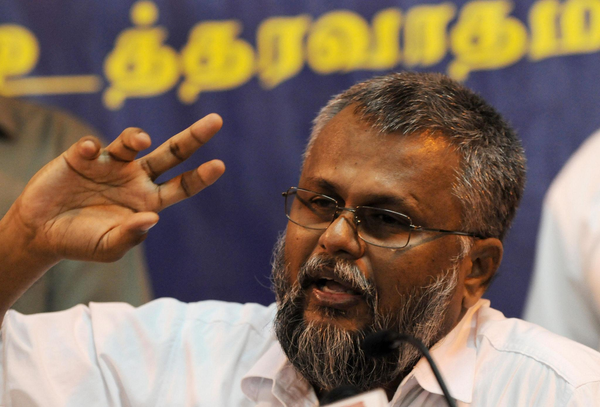
When Tamil leaders from Sri Lanka’s north and east were invited to meet India’s Tamil-speaking Vice-President C.P. Radhakrishnan in Colombo on April 19, there was one notable absentee: many-times MP and minister Douglas Devananda, who heads the Eelam People’s Democratic Party (EPDP).
Puzzled, I telephoned Devananda. “I don’t know,” he said in Tamil when I asked him why he had been excluded from the discussion at the Taj Samudra hotel. There was no rancour in his voice.
I posed the query to other Tamil leaders, including a handful who had the invite, and some Indian officials who have dealt with Sri Lanka.
One speculation was that Douglas was no longer a member of Parliament. That was silly because most of those who met Radhakrishna were not MPs either.
Another source alluded to Douglas’ recent arrest and jailing over a weapon that went missing from a lot provided by the Sri Lankan government.
This was equally bizarre. If criminality was a factor, most Tamil public representatives would fall into the same net. And so would numerous MPs from Sri Lanka’s dominant ruling party, the Janatha Vimukthi Peramuna (JVP).
Who would the Indian government then interact with?
Without doubt, Douglas is one of the most colourful, even if controversial, personalities thrown up by Sri Lanka’s Tamil community.
One of the earliest Tamils to take military training from Palestinian guerrillas in the Middle East, Douglas threw his lot with the Left-leaning Eelam People’s Revolutionary Liberation Front (EPRLF).
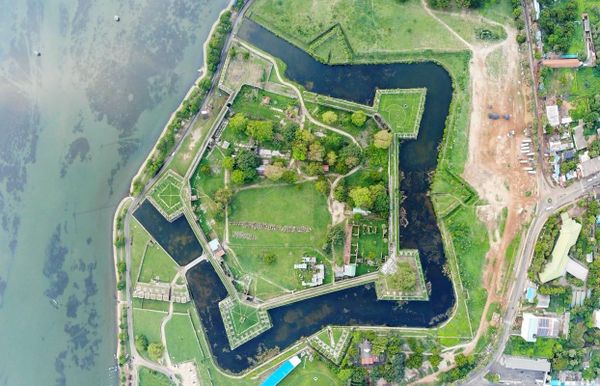
When he headed the EPRLF’s military wing, Douglas had a projectile flung into the Dutch-built Jaffna Fort with a message in Sinhalese scrawled for the soldiers inside: Go back to your villages! We are not against the Sinhalese per se! We are against Sinhalese hegemony!
The message may not have induced the soldiers to flee. But it showed the distinct difference between one section of Tamil militants from the Tigers, who had no compunction in mowing down more than 100 Buddhist pilgrims in Anuradhapura.
Like all Tamil militant groups, the EPRLF too suffered convulsions. Douglas was ousted after being linked to an incident of firing that killed an Indian in Madras. He maintains his innocence in the matter.
The expulsion from the EPRLF led to difficult times for Douglas, who was left with only a small group of loyalists. Money was in short supply. But he somehow survived in Tamil Nadu.
As the LTTE resumed its war after Indian troops went home, Douglas returned to Sri Lanka and threw his lot with the government at the head of the EPDP.
He was clear that the Tigers would never win, that Sri Lanka would not split up, and that Prabhakaran’s uncompromising attitude would only cause more death and destruction for the Tamil community.
Douglas was ridiculed. He was famously dubbed a “traitor” to the Tamil cause. But his assessment proved devastatingly accurate.
Prabhakaran wanted Douglas dead. But Douglas proved to be the proverbial cat with nine lives. The LTTE became frustrated because this was one “traitor” it just could not do away with.
Once, when visiting New Delhi when he was not a minister, Douglas hurriedly vacated his hotel near the heart of the city after spotting a man who looked like a Sri Lankan Tamil, perhaps keeping a watch on him.
When Prabhakaran eventually went down in May 2009, Douglas did something unthinkable: he saved several junior-ranking Tigers, convincing the military that they should not be exterminated or needlessly punished.
Today, scores of ex-LTTE members owe their lives to him. But Douglas did all this quietly, without any drum beating, almost as if it was his duty. And he famously declared many times that he had no problem with any of the LTTE cadres; he had a problem only with Prabhakaran and his fratricidal killings.
Sections of the Tamil diaspora, which remained enamoured of the Tigers, accused Douglas of multiple crimes. Very few knew that many incidents blamed on EPDP cadres were committed without his knowledge, with the Sri Lankan state getting its dirty work done through men it directly controlled; and, as Douglas acknowledged, he could not escape the moral responsibility for that, if any.
No, Douglas is no innocent. If he has blood on his hands, so do many others on the Tamil side, including some who met the Indian vice-president.
Yet, Douglas was kept away from the visiting Indian leader.
When some Tamil fishermen, reportedly linked to the northern leadership of the Janatha Vimukthi Peramuna (JVP), staged a noisy rally recently, demanding that the Indian consulate be ousted from Jaffna, Douglas sent his party colleagues to the Indian mission to assure that the protesters did not reflect the thinking of the larger India-friendly Tamil society.
Yet, India chose not to call Douglas to the Taj Samudra.
Douglas is perhaps the only prominent Tamil leader who has always backed the 13th amendment to the constitution that flowed from the 1987 India-Sri Lanka accord as an interim solution to the Tamil grievances. Some Tamils who supported it did a U-turn when they came under the protective umbrella of the LTTE.
Yet, it is Douglas who could not meet Radhakrishnan while one Tamil political party which did is a bitter foe of the 13th amendment which India is committed to.
Douglas, like all Tamils, has remained steadfastly opposed to the intrusions by Indian bottom trawlers into Sri Lankan waters, a thievery which majorly affects the impoverished Tamil fishing community in the island nation’s north.
Yes, Douglas still has a criminal case going against him in Chennai. But there is no way this could have affected Radhakrishnan because Douglas has met dozens of top Indian officials, including then-Prime Minister Manmohan Singh.
The tragedy with India’s Sri Lanka policy is that key decisions are often taken by small minds lacking institutional memory.
Not extending an invite to Douglas is not just a slap to him or the Tamils he represents, but it also blows a gaping hole in India’s Sri Lanka policy.
Way back in 1987, Sri Lankan Tamils friendly to India were thrust into Akbar Hotel. The man who would eventually kill Rajiv Gandhi was not only royally treated but also given a special appointment with the Indian leader.
Everyone noticed it then, and everyone has now seen how the Indian side dumped Douglas.
Some of those who met Radhakrishnan will surely wonder: Will this happen to us too one day?
Editor’s Note: The author, M. R. Narayan Swamy, has closely followed the Sri Lankan Tamil conflict since 1983. The views expressed are his own and do not necessarily reflect those of Jaffna Monitor.