By M.R. Narayan Swamy
Kandiah Gnanathas can never forget the moment when he came face to face with death: an American-made M-16 grenade launcher.
Only a moment earlier, Kandiah, whose nom de guerre was Sivam, had wondered about the loud boom he had heard. Had some untoward incident occurred outside the house in Jaffna where he was being held prisoner?
As if in answer, he heard pathetic cries in Tamil of people not far away who were running here and there, screaming in fear.
Before he could make sense of what was going on, the wooden door of his room shattered to pieces when a grenade fired from a launcher tore through it and hit several prisoners.
At the doorway stood a grim Aruna, a senior member of the Liberation Tigers of Tamil Eelam (LTTE). He fired again from the powerful grenade launcher at those still barely standing in the cramped room.
“I can never, never forget Aruna’s face,” Kandiah said in a telephonic interview from Mannar, recalling the night of mass murder that unfolded shortly after unknown men attacked the LTTE’s Jaffna commander, Kittu, on March 30, 1987.
Kandiah was one of the many members of the Eelam People’s Revolutionary Liberation Front (EPRLF) who were taken prisoner by the LTTE after they landed in Mannar by boat from India in December the previous year.
That was the month the LTTE, emerging as the new masters of Sri Lanka’s northeast, had “banned” the EPRLF, months after a more vicious crackdown on the Tamil Eelam Liberation Organisation (TELO) that left hundreds dead.
By the time the EPRLF came on the LTTE radar, Kandiah had spent nearly two years in Tamil Nadu, India, undergoing arms and ideological training in pursuit of a struggle for an independent Tamil Eelam homeland.
Soon after the “ban”, the LTTE forcibly took over EPRLF camps and seized both its weaponry and communication equipment across much of the Tamil-majority Northern Province.
Many EPRLF fighters were disarmed and taken captive. Many others escaped.
In Mannar, Kandiah said, the LTTE resorted to trickery. Its Mannar leader Radha, called the EPRLF for “talks”. When an unsuspecting EPRLF responded, everyone was overpowered. Three EPRLF cadres were killed.
In Tamil Nadu, there was panic in the EPRLF camp. Its leader, K. Pathmanabha, made frantic appeals on an EPRLF radio station, saying that every Tamil had a similar goal and that no harm should be done to any EPRLF member.
The LTTE had other ideas. Using the seized EPRLF wireless sets, it forced an EPRLF member to repeatedly tell its India-based leaders that they were holding some Tigers prisoner and therefore urgently needed reinforcements from India, along with weapons.
Falling for the ruse, the EPRLF tried to send some men from Tamil Nadu but failed three or four times due to stepped-up naval presence in the narrow sea that divides India and Sri Lanka.
Finally, on December 30, 1986, a dozen EPRLF members carrying four AK-47 assault rifles and a walkie-talkie landed on the north-western coast of Mannar.
One in the group was a member of the People’s Liberation Organisation of Tamil Eelam (PLOT) who was suffering from acute polio. He was returning to Sri Lanka for medical treatment.
A few LTTE cadres received them on the shore, pretending to be from the EPRLF. The latter didn’t know that the Tigers had overheard the EPRLF leaders instruct the sailing cadres to answer violence with violence.
But the subterfuge didn’t last long. The new arrivals became suspicious when they were not addressed as thozhar (comrade), as was the custom in the left-wing EPRLF.
One thing led to another. It dawned on the EPRLF that something was seriously wrong. The men who received them were not what they claimed to be.
But before they could run back to their boat to escape, the LTTE swooped on them and made them prisoners, Kandiah said. The polio patient, too, was taken in.
The LTTE now had a total of some 35 “prisoners” in Mannar. In no time, the Tigers, who kept accusing Colombo of violating human rights of Tamils, began beating, thrashing and torturing everyone in custody, according to Kandiah.
EPRLF cadres were accused of committing robberies and acting against the war for Tamil Eelam. Some prisoners were beaten more severely than the others.
After a month of agony, the prisoners were blindfolded and shifted to Jaffna, the Tamil heartland, which the LTTE more or less controlled, Kandiah said.
The blindfolds came off only when the whole lot reached a two-storey house away from a main street in Jaffna, surrounded by vegetation.
Parked outside, but within the house courtyard, were vehicles taken from the TELO and EPRLF.
The hands of all the men—mostly in their late teens or 20s—were chained and locked every night, Kandiah recalled. Food packets came every day, but the quality was often poor.
The EPRLF prisoners were kept in one room. TELO captives in another. There was one bathroom-cum-toilet on the ground floor.
There were more prisoners, mostly from TELO, on the first floor too. Kandiah estimated there were some 60 captives in all.
The daily regime included beatings and torture. The same questions were repeatedly flung at them: How many weapons do you have in India? Where have you stored your weapons? How many camps do you have? How many fighters? What did they tell you before sending you here, even after we ‘banned’ you?
Kandiah saw some TELO prisoners being taken away from the house in pairs. They never returned.
One day, when Kandiah went to the back of the house, an elderly man living in a neighbouring house mumbled over the boundary wall: “Thambi, be careful. They are taking away people and shooting them dead.”
The LTTE had not succeeded at that time in imposing a totalitarian regime it later did, choking the Tamil society and stifling its soul.
Another day, the LTTE brought seven dazed Sri Lankan soldiers to the “prison.” According to Kandiah, the seven were killed by the Tigers in October 1987 after a group of LTTE leaders, including Kumarappa and Pulendran, took cyanide and died while in Sri Lankan military custody.
Somehow, Kandiah and the others endured the painful daily routine. No one knew how long the torment would continue.
And then came the mysterious but well-planned attack on Sathasivan Krishnakumar alias Kittu, the Jaffna commander of the LTTE and a childhood friend of Tamil Tigers boss Velupillai Prabhakaran.
The March 30, 1987, assault with grenades and gunfire when Kittu was returning from his girlfriend’s house is widely believed to have been an inside job. The attackers were never caught.
Kittu lost one of his legs, forcing him to quit Jaffna for good.
Masters in diverting attention, the LTTE took out its impotent anger on the scores of helpless Tamil prisoners from other groups it was holding across Jaffna, a gruesome happening recorded by human rights groups too.
This was when the LTTE’s Aruna appeared, along with a fellow Tiger, Kamini, at the house where Kandiah was and unleashed misery through his grenade launcher.
“Before firing the last of the grenades, Aruna abused us in the filthiest manner and yanked off a red thread tied around one prisoner’s neck,” Kandiah said.
“I believe nearly 60 people were massacred that night,” he added. Almost all were TELO and EPRLF prisoners. Also killed was an abducted Jaffna jewellery shop owner who hadn’t paid protection money and his two assistants.
“Believe it or not, they even killed the polio prisoner. His fingers were so deformed that he could not have even pulled a trigger. But they shot him, too.”
Kandiah remembers two EPRLF members from Batticaloa, Rasiq and Papa, who were killed that night. When they realised that they were going to be gunned down, they shouted in unison that they too were warriors for Tamil Eelam.
“Suddenly, gunshots rang out. Then there was silence. Both were dead.”
Wounded in the leg and back, Kandiah collapsed in pain and agony. Before fainting, he saw several others lying dead in small pools of blood. One person had been shot in the head, his skull breaking up.
It was all over in 15-20 minutes. Aruna left the house-cum-prison like a victor.
But some of those who were shot were alive, and in visible pain. When Kandiah came to his senses, he heard painful cries around him. One person was screaming: “Water, water!”
Although he himself was in excruciating pain, Kandiah staggered towards the bath to get water for the dying young man.
He was still in the bathing area when a fuming Sathiya, the head of the “prison”, stormed in. Kandiah, from inside the bath, initially heard him asking who had committed this atrocity.
And then, in a strange twist of circumstances, Sathiya himself began shooting at the survivors with a pistol, Kandiah said. For good measure, someone else opened up with an AK-47.
“With that, everyone in the house was dead. Everyone means everyone. The killers left. The house became very quiet. Only dogs were barking furiously outside.”
Kandiah, now without a shirt, came out of the house, haltingly and in fear, to see no one except a young LTTE sentry.
The sentry, probably made of a different mould, took pity on him. He let Kandiah go after telling him to get back to the house and put on a shirt.
“That night the Tigers committed more than one mass killing,” he said.
Unfamiliar with Jaffna, Kandiah was walking with a limp along a deserted and dark street when a van came down the main road. It belonged to the LTTE and was apparently moving to the house to collect the blood-soaked bodies.
With quick thinking, Kandiah pretended to be urinating on the side path. The van’s occupants didn’t pay heed.
The dazed EPRLF guerrilla took shelter at the house of a stranger for a night and at a barren cemetery for four more nights, battling fatigue, pain, and hunger.
Later, he made it to the Jaffna bus stand to go back to Mannar. But he fell into the hands of the Sri Lankan military as he didn’t have a National ID card.
He tried to bluff that he got injured while committing a robbery, but the truth came out. He was arrested and thrashed, now by soldiers, and jailed.
Kandiah was about to be sent to prison after being sentenced when the India-Sri Lanka Accord was signed on July 29, 1987.
In line with it, all Tamil political prisoners were released. Kandiah finally found his freedom – after six months of confinement.
How Kandiah, now around 60, spent the subsequent decades, till Prabhakaran and the LTTE were crushed militarily in 2009, can fill a book.
He spent years in part in Tamil Nadu and the Gulf and in greater part in Sri Lanka. He remained a bitter ideological foe of the Tigers. Much of his life was spent enduring physical and mental agony.
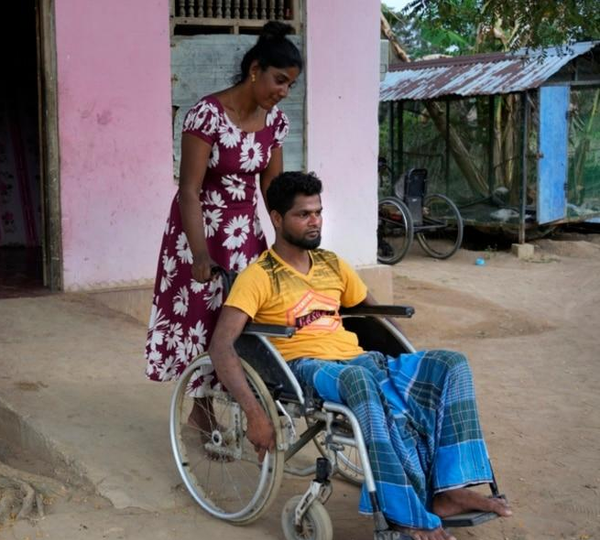
But Kandiah—now a diabetic and a father of three who manages cattle for a living—can never forget his early beginnings or the way the LTTE treated him and other Tamils.
“When I set out from home at age 19, I was angry about the way the Sinhalese had treated us in 1983. All of us wanted justice for the Tamils. We didn’t know who Prabhakaran was or who Pathmanabha was. It didn’t matter.
“I may have joined one militant group, and others may have joined other outfits. So what? Our goal was the same, wasn’t it?
“But the LTTE destroyed everything. Their fascism destroyed the Tamil society.”
Surprisingly, he is not angry at the mass of LTTE fighters who surrendered to the military in 2009, after over a quarter century of bloodshed.
“Some ex-Tigers have apologised to me. They say they were brainwashed. They didn’t know what they were doing till it was too late.
“I believe them. After all, I am alive today because a young LTTE sentry allowed me to go in 1987, right? That boy took an enormous risk and saved me.
“It is the LTTE leadership, Prabhakaran in particular, who must be held primarily responsible for the mess the Tamil society is in today.
“In his blind chase for Tamil leadership, he killed thousands of Tamils who did not agree with him. Ultimately, he too died. What did he achieve for the Tamils?”