By M.R. Narayan Swamy
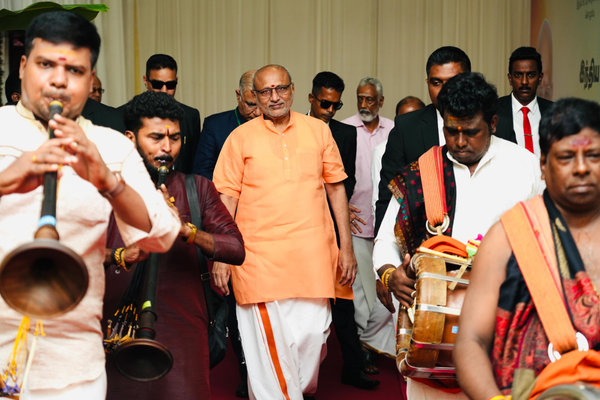
India has taken a strategic decision to help tens of thousands of Sri Lankans obtain Overseas Citizen of India (OCI) status during a packed two-day visit to the island nation by Vice President C. P. Radhakrishnan, a move that Tamil leaders across the political spectrum described as positive and emotionally fulfilling.
Although the visit saw India and Sri Lanka deepen their growing bilateral ties, Tamil leaders from the country’s North and East, along with representatives of the Indian-origin Tamil community, gave a thumbs up following their interaction with C. P. Radhakrishnan.
Radhakrishnan, who assumed the vice-presidency in September 2025, is the most senior Tamil from the Indian establishment to visit Sri Lanka after the 2015 journey by then President APJ Abdul Kalam. But unlike Kalam, Radhakrishnan has been in politics for decades in Tamil Nadu, where Sri Lankan issues always cast a shadow.
One of the most significant Indian government decisions, which Radhakrishnan announced to applause at a community gathering in Colombo on Sunday evening, was to simplify the process of granting OCI status — extending eligibility to sixth-generation descendants of Indian-origin Tamils, in line with similar measures introduced for Indian-origin communities in countries such as Mauritius.
He had announced this earlier at a closed-door meeting with Indian Tamil leaders, including Mano Ganesan of the Tamil Progressive Alliance (TPA) and Senthil Thondaman of the Ceylon Workers’ Congress (CWC).
TPA Vice President Barath Arullsamy, who also attended the meeting, said the Indian decision would make some 1.5 million Tamils of Indian origin eligible for OCI status if they met the conditions. He added that he expected at least 500,000 to apply immediately.
An OCI card, issued after strict vetting, helps members of the Indian diaspora who are citizens of other countries visit India without obtaining a visa each time and enjoy other benefits available to Indian citizens.
“The only bar is we cannot vote or contest Indian elections, and we cannot buy agricultural land,” said Arullsamy, whose great-grandparents made Sri Lanka their home in the early part of the last century.
Tamil leaders said the decision, which New Delhi unveiled as part of a larger bilateral package, would greatly expand India’s strategic footprint in Sri Lanka, with tens of thousands receiving OCI status across 12 districts, including Nuwara Eliya, Kandy, Badulla, and the capital, Colombo.
“This opens a new chapter in our relations with India even as we remain Sri Lankan citizens,” said Arullsamy. “It is an extremely important development.”
As of early 2026, India has issued more than 5.35 million OCI cards globally. The OCI programme, which began in 2005, has seen a rapid growth in the last decade. The Indian diaspora population totals around 35 million, and many amongst them yearn for deeper ties with their home country.
Until Sunday’s announcement, getting an OCI card was strenuous for the Indian Tamil community that has had an uneasy existence in Sri Lanka since the British brought them as indentured labourers from India from the 1820s.
Sri Lanka declared the Indian Tamil community, which at one time worked exclusively in plantations, stateless upon independence in 1948. It took many years of intense negotiations with the Indian government to resolve the issue, even as tens of thousands were repatriated back to India.
Tamil sources say that, had the repatriation not taken place, the Tamil community as a whole would today have been able to elect more than 50 MPs in Sri Lanka, including those from the Northern and Eastern Provinces.
Radhakrishnan also announced enhanced educational scholarships to children from the Indian Tamil community to study in India. This was another long-pending demand.
Earlier on Sunday, Radhakrishnan and Sri Lankan President Anura Dissanayake discussed a wide range of issues, including the economy, energy, education, health, tourism, investment, and trade.
This includes efforts to build an energy hub in the eastern port city of Trincomalee involving both India and the United Arab Emirates. The matter has gained heightened interest in the wake of the Iran-US-Israel conflict and the resultant turmoil in the global energy sector.
Radhakrishnan, who was accompanied by Indian Foreign Secretary Vikram Misri, also discussed the unending row involving Indian trawlers fishing illegally in Sri Lankan waters, frequently leading to the arrest of Indian fishermen.
The Indian leader also urged Dissanayake to hold provincial council elections without further delay.
The elections, a fallout of the 1987 India–Sri Lanka Accord, which sought to end Tamil separatism, seek to grant limited autonomy to the country’s nine provinces, including the North and East, where Tamils live in large numbers.
Citing different reasons, Colombo has repeatedly postponed the elections, although Dissanayake had pledged before winning parliamentary elections in 2024 that they would be held within a year of his taking power.
The need for provincial councils and for a more equitable distribution of power-sharing among different ethnic groups in Sri Lanka came up during talks Tamil leaders from the north and east had with Radhakrishnan on Sunday.
MA Sumanthiran, a leader of the Ilankai Tamil Arasu Katchi, the main Tamil party in Sri Lanka, quoted Radhakrishnan as saying: “Our position is clear. India’s stand has not changed on the (1987) accord.”
Tamil leaders also raised the persistent failure of the military to vacate civilian land and property occupied during the war against the Tamil Tigers and to restore ownership to Tamil civilians, primarily in the North.
Radhakrishnan expressed his sympathy for the thousands of Sri Lankan Tamils living as refugees in Tamil Nadu for decades and promised to share the concerns of the Tamil leaders with the Indian government leadership.
“It was a very good and productive meeting,” Sumanthiran told the Jaffna Monitor.
Five-time MP Dharmalingam Siddharthan of the Democratic Tamil National Alliance echoed the sentiment, saying the Tamil leaders felt at home and “very comfortable” while discussing issues with Radhakrishnan.
“It became quickly clear to all of us that he (Radhakrishnan) knows the Sri Lankan realities,” Siddharthan said.
Indeed, the Indian Vice President stunned Siddharthan and his colleague Selvam Adaikalanathan by recalling the now late leaders of their respective Tamil groups, who had met him in Tamil Nadu in the 1980s.
The TPA’s Arullsamy said Radhakrishnan became emotional at one point while discussing the plight of Indian Tamils who came as indentured labourers to Sri Lanka.
“He got emotional, and we also became emotional,” Arullsamy said. “We really didn’t expect this. We felt very comfortable talking in Tamil.”
Separately, Foreign Secretary Misri announced that the Colombo Security Conclave (CSC) would be given the status of an international organisation with an Indian national as its first secretary general.
The CSC is a regional maritime security grouping set up in 2020 and includes India, Sri Lanka, the Maldives, Mauritius, Bangladesh, and Seychelles.