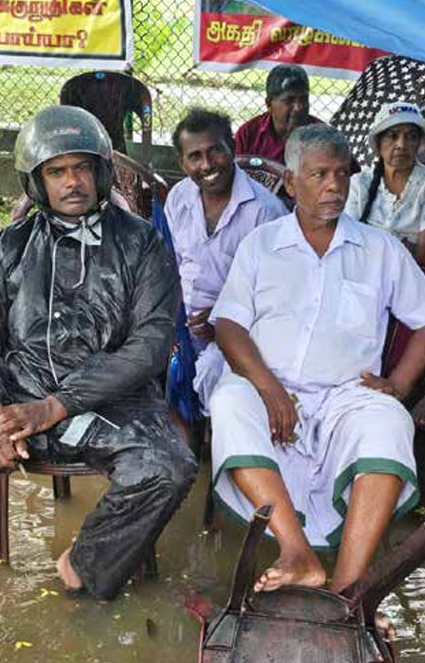
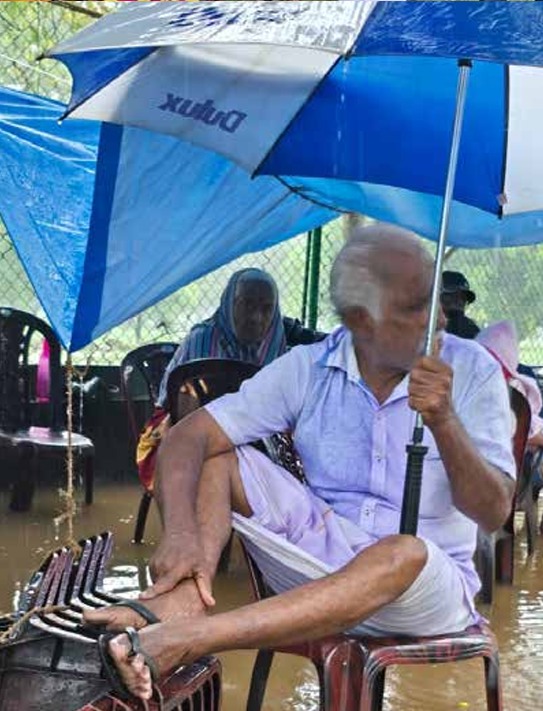
Braving torrential rain, displaced Tamil residents of Valikamam North gathered for the fourth consecutive Friday outside the gates of the Sri Lanka Army’s Commando bungalow in Jaffna, demanding the return of approximately 651 acres of ancestral land from which they were forcibly displaced in June 1990 and to which they have been denied access for 34 years.
The demonstration, which began on April 24 as a weekly series, is being carried out by landowners belonging to Grama Sevaka divisions 248, 251, 255 and 256 of Valikamam North — families who have spent more than three decades scattered across other parts of the Northern Province and abroad while the military retains control of their properties under a High Security Zone designation that has outlasted the civil war by 17 years.
"This protest will not cease until our lands are returned to us," demonstrators declared on Friday, standing in heavy rain outside the compound.
A ZONE THAT OUTLIVED THE WAR
In June 1990, as the Sri Lankan military expanded operations around the Palaly airbase and Kankesanthurai harbor, thousands of Tamil families were ordered out of their homes across 13 Grama Niladhari divisions under the Valikamam North Divisional Secretariat. The area was subsequently declared a High Security Zone and placed under military administration. Homes, agricultural fields, fishing grounds, schools, temples, churches, and community halls were absorbed into the zone.
The war ended in May 2009. But the High Security Zone continued. More than 6,000 families from Valikamam North remain displaced, according to figures cited by civil society organizations and local representatives. The Valikamam North Land Release Committee has stated that nearly 2,900 acres remain unreleased despite five presidential changes and four parliaments since the war's end.
"Although 16 years have passed since the end of the war, our lands remain under the control of the Sri Lankan military under the continuing pretext of a High Security Zone," said Velautham, a displaced Valikamam North resident, speaking to Jaffna Monitor.
GOVERNMENT CLAIMS DISPUTED
The administration of President Anura Kumara Dissanayake, elected in late 2024 on pledges to resolve longstanding ethnic grievances, has announced fresh land releases in the Northern Province. In a defense advisory committee meeting in Parliament, the President stated that approximately 1,000 acres of private land in the North had been released during 2025.
Deputy Defense Minister Major General (Retired) Arun Jayasekara provided more specific figures in April, telling Parliament that 672.24 acres — comprising 86.24 acres of private land and 586 acres of state land previously used by the military — had been released between January and October 2025. Jayasekara told reporters that land release would not pose any threat to national security.
Tamil political representatives and displaced residents dispute the government's framing. In Valikamam North alone, approximately 2,200 acres of agricultural land are said to remain unreleased. "Every government announces land releases, but the vast majority of our occupied lands remain unchanged," said Murugupillai, 72, a displaced resident, speaking to Jaffna Monitor. "We can see that this government is continuing the same pattern."
WHAT THE MILITARY DOES ON THE LAND
Land rights activists and affected residents say the military does not merely occupy civilian property but derives economic benefit from it. Sources familiar with land-use patterns in Valikamam North told Jaffna Monitor that military personnel have established agricultural operations on substantial portions of the occupied land within the High Security Zone, with additional areas reportedly converted into recreational and commercial facilities.
Residents and advocates allege that produce cultivated on privately owned civilian lands is subsequently sold in local Tamil-majority markets — forcing original landowners to purchase goods grown on their own confiscated property.
Rathinasingam Muralitharan, leader of the Northern Province People's Organization for Land Rights, said the prolonged occupation extends beyond any legitimate security justification. "While lands in other parts of the country may be acquired in the name of development, in the North and East, Tamil lands continue to be seized under the pretext of security," he said. "The continuous occupation has stripped people not only of their livelihoods, but also of their peace. Our demand is simple: the people's lands must be returned to the people."