
Translated from the original Tamil short story vali (வலி) from the 1976 collection of short stories titled kōṭukaḷum kōlaṅkalum (கோடுகளும் கோலங்களும்) by Kuppilan Ai. Shanmugan. The original collection is available at noolaham.org. If you have any questions or feedback, please contact ez.iniyavan@gmail.com.
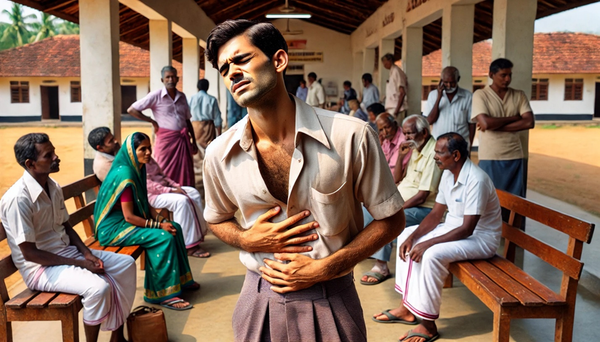
The intermittent shooting pain struck the lower right part of his chest. He could never predict when the pain would hit. It could come any time, even in the dead of night when he was fast asleep. The pulsating pain would last for about five minutes, leading him to despair at the meaninglessness of life, inducing him to want to cry out in pain, making him moan, “Ammā, ammā…”
But his face betrayed only a faint shadow of the invisible thread of pain. His left hand would unconsciously caress the place in his chest where the pain hit him, even as he continued to work. He might be leafing through files at the office, traveling by train or bus, watching the exquisite beauty of the evening descending on the beach; or debating his friends. Sometimes he might even smile—a smile laced with a tinge of pain.
It had been about three months since the pain started. He learned to grit his teeth and endure it until it became unbearable. After crossing his threshold for tolerance, he decided to seek a remedy. The very decision brought him joy. But, with his characteristic laziness, he did not get around to seeking treatment. Putting up with the pain seemed to stretch the days.
His friend would scold him, “Why do you suffer needlessly in this age of science? For all your pontificating, you are just lazy. You should heal yourself first before you presume to prescribe solutions for others.”
Finally, one day, all these pressures induced him to find a remedy. He remembered that it was about ten in the morning when he left home. He went on foot, walking for about a mile, the overcast sky shielding him from the harsh sun. As he walked, he observed families living in apartment buildings, children running around naked, the vegetable seller pushing his cart along, the incessant ringing of bicycle bells, the young mother on the railway station bench with a baby on her lap. These lively movements of the day filled the senses.
“Why didn’t this feeling bother me until now?”
He felt an intense shooting pain in the lower right part of his chest. He wanted to cry out loud. In three minutes, the pain subsided.
The sky cleared and the sun shone with full ferocity; the cool- drinks factory lay behind the tall wall along the street featuring a huge advertisement showing a woman drinking soda. A lush cornfield stretched between the canal and the road, where a man in a hat stood irrigating the crops.. As he drew closer, he could see beads of sweat on the man’s face. Government offices. appeared, with notice boards in all three languages. Buses rushed past. Flowers rained down from the shady trees that lined the trees.
He spotted the smartly dressed man sitting on a chair in a modest room on one side of the hospital. The man was surrounded by beakers and test tubes, and a sharp chemical odor filled the air.
With a smile, he proffered the introductory letter his friend had written for him. The man glanced through the letter and launched into the customary inquiries: about his name, village, friends, and relatives.
Then the man led him through the crowd of patients thronging the entrance to the doctor’s office and introduced him to the doctor.
“He is my relative; works for the Department of Education.”
The doctor peered at him, “What ails you?”
He peered back and answered something. He sensed a sadness that pervaded the depths of the doctor’s mesmerizing eyes, along with a compassion that felt like a warm embrace. The doctor did have a rather long nose.
The doctor looked at him again, this time with a stern expression.
“I say, do you drink a lot? Are you into the habit of drinking moonshine?”
He shook his head pitiably, “I don’t even smoke.”
“So maybe you eat a lot of meat and spicy stuff?”
“I am a vegetarian,” he responded softly.
The doctor gazed at him with disbelief, shook his head, and asked him to leave the room, but the “relative” stayed behind.
He walked out unsteadily. The shooting chest pain reappeared.
A listless baby. An old man with an incessant cough, spitting out phlegm. A young man with a pencil mustache and a bandage around his head. An exhausted pregnant woman. And some others. At a distance, two construction workers standing on a wooden plank laid across bamboo scaffoldings, stacking red bricks to construct a new floor in a building.
He was waiting by the entrance to the doctor’s office. The “relative” walked quietly towards him, looking tired. Even when he asked the “relative” about the doctor’s diagnosis, there was no clear answer. Perhaps it was not something he was supposed to know; perhaps the relative surmised that he would be distraught if he heard the news. Truth be told, he did not really care what the diagnosis was. Perhaps it was his laziness, or perhaps his aloofness from life, that made him indifferent to what would happen to him.
The next time he went to see his “relative”, he had a bit more energy. His face was clear, the tiredness in his eyes had disappeared, and his cheeks were fuller. Even his speech was softer, more elegant, and more confident.
His “relative” was surprised. Even the doctor was taken aback but tried not to show it. The doctor regarded him with those mesmerizing eyes and said, “It seems you worry a lot. Don’t worry about problems. Who doesn’t have problems?”
He remained silent, a rush of thoughts flooding his mind. The listless baby, the old man spitting out phlegm, the construction workers building a yet another floor, the beads of sweat lacing the fisherman’s face….
“My dear boy,” the doctor’s voice had a certain majesty. “No one is free of problems. Don’t worry too much. Do you know that unnecessary worry can cause stomach ulcers?”
He was a new man when he emerged from the hospital. The whole world shone with a certain mesmerizing magnetism. He felt that life was full of meaning. He even remembered her smiling face, after a three-month gap. He started mumbling a song, and even his gait had a certain majesty.
The same street, the same path.
Naked children roamed the street.
The young man with frustrated eyes and a week-old stubble, held the hem of his sarong with his left hand and stared emptily onto the street.
The crippled beggar.
The thirty-year old spinster who stood by her front door people-watching with a certain longing in her eyes.
A brightly painted poster on the wall screamed in big red letters about how the fascist rule in Chile was oppressing its people.
His face darkened. The mumbled song suddenly went quiet. As the shadow of pain shrouded his eyes, the fingers of his left hand clutched the right side of his chest.
He realized that the pain that had been absent for a week had decided to return.
“Chai—how painful!’
He resolved to find a permanent remedy.
1974