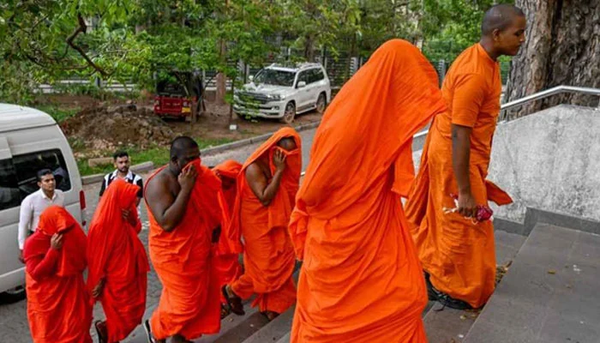
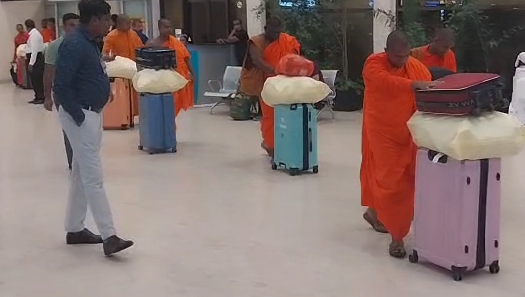
Colombo — Shortly after 10 p.m. on a Saturday in late April, a Thai AirAsia jet from Bangkok touched down at Bandaranaike International Airport. Among the passengers, twenty-two young men in saffron robes filed quietly toward the arrivals hall, the way Buddhist monks in transit have moved through this airport for decades — without much notice, and almost without question.
They did not get that far.
By dawn on Sunday, officers of the Police Narcotics Bureau had laid out the contents of their suitcases on inspection tables: vacuum-sealed packets of high-potency cannabis and hashish, tucked beneath schoolbooks, soap, toothpaste, and bags of sweets. The total weight, officials said, came to more than 110 kilograms, with a street value the police placed at over 1.1 billion rupees — about 3.6 million U.S. dollars.
It was the largest narcotics seizure in the history of Sri Lanka’s main international airport. It was also, officials said, the first time Buddhist monks had been caught carrying a consignment of this scale.
In the days since, the case has widened beyond the men in robes. The Police Narcotics Bureau has arrested an additional monk in Meegahawatta, in the Gampaha District, whom officers have identified as the principal organizer of the Thailand trip. Investigators say that at least three other monks, allegedly operating from a temple in the Jamburaliya area, helped recruit the couriers — in some cases through Facebook and WhatsApp groups — and had traveled to Bangkok on multiple earlier occasions.
A Trip Arranged Elsewhere
The men arrested on the night of April 25 came from across the country: from Ampara in the east, Horana, Boralesgamuwa, and Wadduwa in the west, and from towns as scattered as Warakapola, Athuraliya, Ambalangoda, Madapatha, and Balangoda. They were between 19 and 28 years old, according to the police, and many were said to be pursuing higher education at religious institutes.
According to police accounts, the group flew to Bangkok on April 22, on tickets paid for by a sponsor whom the authorities have so far declined to name. They returned together four days later, on Thai AirAsia flight FD-140, arriving around 10:10 p.m. Some of the suspects, the police say, have told investigators they understood the trip as a religious or educational visit, and believed they were transporting school supplies and confectionery for children at temples in Sri Lanka.
The contents of their phones, recovered after the arrests, suggest a different kind of trip. According to officers familiar with the investigation, the devices contained photographs and videos of some of the men in civilian clothes during their stay in Bangkok, in settings that were neither religious nor austere. A police source told Jaffna Monitor that some had disrobed entirely and engaged in leisure activities, including what he described as “deeply worldly interactions” with women — a temporary return to samsara.
Police now say that at least three members of the arrested group had traveled to Bangkok on earlier occasions. Three more monks — the alleged organizers from a temple in the Jamburaliya area — are reported to have made the trip multiple times. The pattern points away from a single, opportunistic smuggling attempt and toward a route that had been tested, refined, and repeatedly used.
How the Drugs Travelled
The contraband seized at the airport was not ordinary cannabis. Police identified the bulk of the haul — roughly 101 kilograms — as Kush, a synthetic-laced strain that has spread through South Asia in the past two years. The remaining 10 kilograms or so was hashish.
Kush first emerged in Sierra Leone, where it has driven what may be the most lethal drug crisis in West Africa in recent memory. By April 2024, the public health impact was severe enough that President Julius Maada Bio declared a national emergency on substance abuse, a step shortly mirrored by Liberia. Chemical testing led by the Global Initiative Against Transnational Organised Crime, published in 2024, identified Kush's active ingredients as a combination of nitazenes — synthetic opioids that researchers describe as being as much as twenty-five times more powerful than fentanyl — and synthetic cannabinoids. In Sri Lanka, where customs officials have stated that a single gram of Kush sells on the street for about 10,000 rupees, the economics of moving it have become difficult to ignore.
Each suitcase recovered at the airport, the police said, contained roughly five kilograms of narcotics, packed beneath consumer goods inside false-bottom compartments. The concealment was uniform across the group's luggage — identical methods, identical disguises — a level of coordination investigators say is consistent with an established trafficking network rather than a series of independent decisions.
The arrests followed a tip received by the Police Narcotics Bureau and were not the result of a routine inspection. In the days since, officials have acknowledged what the scale of the seizure had already suggested: that a smuggling route, built in part on the perceived sanctity of religious travelers — particularly Buddhist monks — had, until that night, operated largely undetected.
A Pattern, Not an Anomaly
The Bangkok-to-Colombo corridor has been on the radar of Sri Lankan customs for some time. In May 2025, Charlotte May Lee, a 21-year-old former British flight attendant, was arrested at the same airport after arriving from Bangkok with 46 kilograms of Kush hidden in vacuum-sealed packets in her luggage. Customs officials at the time called it the largest Kush seizure in the airport's history. Within days, separate cases involving an Indian and a Thai national, both also arriving from Bangkok, were uncovered.
Sri Lankan customs officials have publicly traced part of the surge to Thailand's 2022 decision to decriminalise cannabis — a policy now under partial reversal — which transformed the country into a regional supply point. The young women caught at airports across the world earlier in 2025 had, in several cases, been recruited by men they had met in Thailand.
What distinguishes the April 25 arrests is the apparent use of religious identity as a layer of protection. In Sri Lanka, where roughly 70 percent of the population is Buddhist, the saffron robe carries both social and bureaucratic weight. Monks are often afforded discounted travel, designated front-row seating on public transport — privileges that are not always extended even to pregnant women — and, by long-standing convention, a measure of deference at security checkpoints.
These practices are deeply embedded in everyday life, which is precisely what makes them useful, from a smuggler’s point of view.
"This is not just a drug case," a senior security official said, speaking on condition of anonymity because he was not authorized to speak publicly about an active investigation. "It is about how networks identify and use social blind spots."
The Recruiters and the Recruited
In the early hours of Sunday, while the 22 men were being processed at the airport, police officers in the Meegahawatta area of Gampaha arrested a monk whom investigators have identified as the principal organiser of the Thailand trip. He is alleged to have planned the logistics of the journey, sourced the airline tickets, and coordinated with the men once they reached Bangkok.
Investigators believe he did not act alone. According to police accounts, three monks based at a temple in the Jamburaliya area of Gampaha district allegedly recruited 19 of the couriers, several of them through Facebook, and presented the trip as a sponsored religious visit. By the time of writing, the police had described a network of roughly 25 monks under detention or active investigation, including the alleged organisers.
On April 26, the 22 men arrested at the airport were produced before the Negombo Magistrate’s Court, which ordered them held for seven days for further questioning. Police officials have indicated that more arrests are likely as the investigation expands.
What has not yet emerged publicly is the identity of the sponsor — the person or persons who paid for the airline tickets and, in all probability, supplied the drugs in Thailand. A Sri Lankan customs spokesman described the trip as a four-day holiday funded by a businessman.
The financial trail, the Thai end of the supply chain, and the question of whether other groups may still be in the pipeline remain, for now, the central unresolved threads of the case.
A Reckoning Inside the Sangha
By Sunday evening, the case had reached the highest levels of Sri Lanka’s Buddhist establishment. The Mahanayake Theros of the three Nikayas — the senior prelates of the country’s main monastic orders — issued a joint statement condemning what they described as the anti-Sasana, anti-social and unlawful conduct of those who had misused the robe to traffic narcotics.
They called on the state to introduce legal mechanisms to identify and remove impostors from the order — a proposal that, if pursued without exception, could remove a significant number of monks — and urged senior monks to keep closer watch over their younger charges.
The statement was notable less for what it condemned than for what it appeared to concede. By framing the suspects as impostors rather than as monks who had gone astray, the prelates seemed to seek to preserve the institutional credibility of the Sangha.
Police have not yet publicly confirmed how many of the 22 men were fully ordained, how many were novices, and how many, if any, had simply donned robes for the journey. The legal status of each suspect — and the question of whether some were knowing participants while others were unwitting couriers — remains among the issues investigators say they are still working to establish.
What the Case Has Not Yet Answered
Sri Lanka has long grappled with a narcotics problem that far exceeds its size. Heroin moves along its southern coast, ferried by fishing vessels from staging points off Iran and Pakistan; cocaine has surfaced periodically in container shipments through the Colombo port; and synthetic drugs, including methamphetamine and now Kush, have arrived increasingly by air, often via Bangkok. Each new pattern tends to expose a different vulnerability in the country’s enforcement architecture.
The April 25 case has done more than most. It has raised questions that the police investigation, however thorough, may not be able to answer on its own:
Who, in Bangkok, prepared and handed over the consignment, and whether the same network is continuing to move couriers through other airports.
How many earlier trips — including a reported journey involving twelve monks in the previous months — succeeded, and what became of the drugs that may have entered the country undetected.
Whether the recruiters were acting on behalf of an established Sri Lankan trafficking syndicate, or whether they had begun to build a network of their own, organized around the specific cover that monastic identity provides.
And what duty of care, if any, the country’s temples owe to the young — often economically vulnerable — novices in their charge, particularly when those novices are approached by older monks offering travel abroad and small sums of money.
At the center of it all lies a more difficult question: whether the men in robes were merely couriers for a network operating beyond them, or whether elements within the monastic sphere had themselves begun to organize and sustain a trafficking operation.