

Mahesh Nirmalan MD, FRCA, PhD, FFICM, University of Manchester, United Kingdom
Human life is defined by a deep-seated paradox which at times may seem unsurmountable. On the one hand we are biological organisms subject to the rules of physics and chemistry and therefore subject to entropy, decay and dissolution. We get hungry, tired, we age and ultimately, we all cease to function. Yet within this fragile and time limited existence there remains a sense of ‘I’ or ‘me’ that feels constant. Despite the majority of cells in the body being replaced many times over, we perceive a continuity - memories, personal qualities and traits that flow seamlessly despite the structural changes that invariably accompany renewal of all bodily cells. We have a hunger for purpose that transcends mere survival, a capacity for love and hatred that defies logic and an inner witness that remains strangely constant through these experiences. This tension between our status as changing ‘objects’ in the world and our experience as unchanging ‘subjects’ of the world is referred to as the Human Paradox. No ancient text - anywhere in the world, has addressed this paradox with clarity, precision and depth as the Bhagavad Gita. Written (probably) over two millennia ago, the Gita does not merely provide an explanation, but also goes on to describe how peace and reconciliation is possible within this paradox.
What are we?: To grasp the Gita’s solution it is first necessary to look at the structural basis of this paradox. Most people view themselves as a mind-body duality. Gita however presents the view that this duality may be an oversimplification and proposes a hierarchy that extends from the physical to the spiritual. In Chapter 3 Verse 42, Gita explicitly presents a four – layered model to define the human condition:
The body and senses (Kaya): The outer most layer
The mind (Manas): The processor of the sensory input and the source of emotions and therefore an extension of the body and the sense organs.
The intellect (Buddhi): The source of reason, judgement and memory.
The self (Atman): The pure and unchanging observer.
The human paradox arises because ‘science’ dictates that we are the body and/or our thoughts, which are defined through our sensory inputs with a limited bandwidth. This implies that when our body fails and the mind is clouded ‘we’ are being destroyed. Gita’s primary purpose is to teach us to shift our sense of ‘I’ from the first three layers to the fourth and in doing so Gita assumes a unique position amongst all spiritual and religious texts. A sceptic rooted in hard reductionistic science may argue that once you strip away the body, the senses and the resulting emotions what remains is ‘nothingness’. Gita - taking a more integrated approach, argues that this ‘nothingness’ is the ‘everything’ that matters and hence the object of focus in resolving the human paradox.
Realities of existence: The Gita frames existence as an intersection between two distinct realms – Nature and Consciousness. The ever-changing nature – both internal and external, is referred to as ‘Prakriti’ and includes everything material that we know of including our DNA, neural pathways, sensory experiences, memories, objects that we own and the environment we live in. Beyond this everchanging nature lies an unchanging and eternal consciousness or ‘Purusha’ acting as the knower of this ever changing internal and external landscape. All of creation is an intersection between these two realms and, according to Gita, the human paradox arises because of the ignorance of this interplay between nature and consciousness. The Gita’s position is that when the ‘Knower’ (or the ‘Purusha’) - out of ignorance, gets entangled in the transient manifestations of the Prakriti (or the ‘Field’) and mistakenly identifies his or her reality as that of the ever-changing ‘Field’ suffering is inevitable. It is akin to actors who have played their roles for so long that they have forgotten their real names and endure the sufferings of the characters they are playing. Gita firmly articulates the view that the tragedy of the human condition is not that we are subject to decay or that we are mortal but that we think we are only the part of us that is subject to decay and is therefore mortal. In suggesting that existence is a ‘field’ (or Kshetra) and we the ‘knowers of the field’ (or Kshetrajna) can act in the field without being bound by it (or bound to it) - effectively aligning their individual existence with a cosmic whole, Gita is offering a practical recipe to overcome the grief and suffering. This world view was expanded further and better articulated by subsequent generations of ‘Advaita Vedanthies’ such as Adi Shankara in 8th century CE.
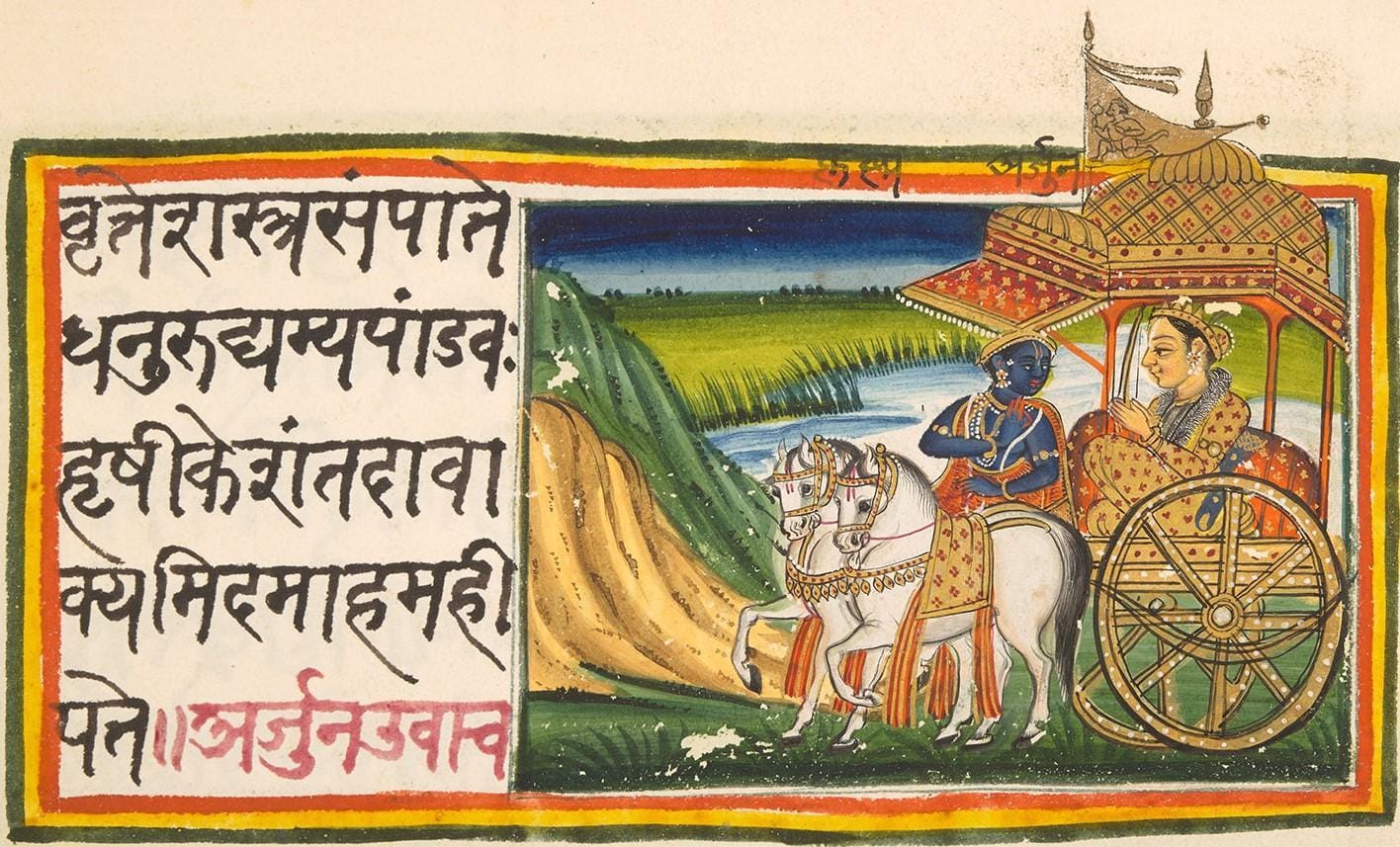
Action without attachment: In this context it would not be unreasonable to question if we are truly an ‘unchanging observer’ why should we be concerned over the comings and goings in the mundane world? Why cannot we isolate ourselves in a cave immune to the sufferings and challenges around us? It is in its response to this question that Gita becomes a practical manual for the living by promoting the idea of selfless action (or ‘Nishkama Karma’). Gita argues that as we are all part of the ‘Field’ it is in our nature to act. Hence inaction, goes against our very nature and cannot lead to happiness or contentment. The paradox of living according to Gita is therefore that we must be fully engaged in our duties while being internally detached from the outcome of our actions. Clearly Gita’s position is that the outcome in any situation is determined by a multitude of factors over which the ‘doer’ has little control. Most of the stress in daily life arises from the ‘future self’ – the part of us that agonises over the outcome of our actions. By identifying ourselves as the ‘silent witness’ we are able to commit fully to any action because our sense of worth is no longer tied to whether we win or lose. We act appropriately in all situations because it is the right thing to do rather than to feed an ever-hungry ego craving for success.
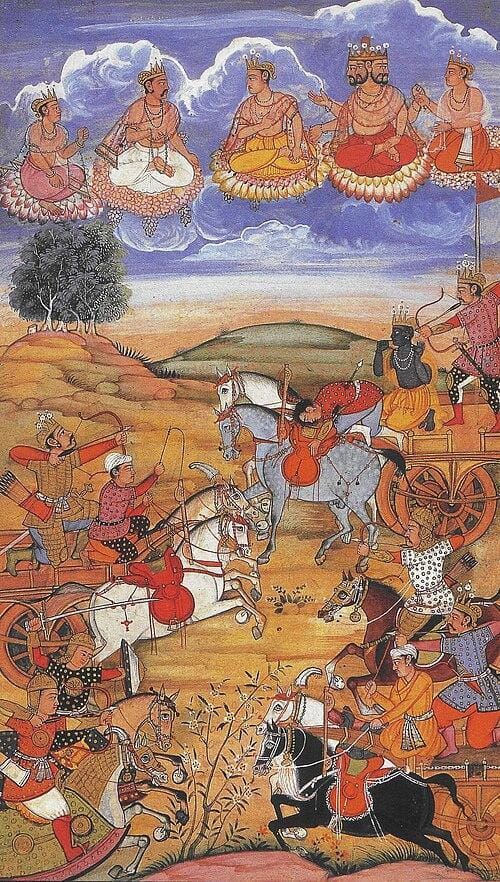
The Gita resolves the human paradox by articulating the view that we are not a human being having a spiritual experience but rather a spiritual entity having a human experience. By understanding the layers of our own existence we live our lives with a double vision which enables us to experience all the changes – the ageing, the loss and the disintegration, but yet rest in the knowledge that there is a part of us and every other living being that is eternal. Within such a double – visioned world view compassion, love and understanding towards all life forms - born and unborn, become inevitable outcomes.
The social paradox of Gita: When reflecting on the above analyses, it is hard not to be amazed by the fact that a person or persons, living almost 2 millenia ago, in a harsh and untamed world where day to day survival was at stake; had the time, patience and intellect to ponder upon such intricate issues. These were no doubt very sophisticated minds that contemplated deeply and came up with ‘solutions’ that may or may not be in agreement with our current understandings of creation. But clearly, they saw human suffering and proposed a recipe that fostered internal harmony and social co-existence thereby mitigating against the root causes for strife. But the paradox that needs further consideration is how such an inclusive and forward-looking text could also form the basis of arguments that have nurtured (or been used to justify) the highly detrimental and divisive caste system widely prevalent in the sub-continent and Sri Lanka.
Bhagavad Gita explicitly reinforces the four-fold order (or Varna) in society but rejects the rigid birth-based caste system that has come to plague these societies. Despite 40 years of war and destruction, there is no doubt that caste based discrimination is strongly embedded within Tamil/Hindu communities in Sri Lanka and within the Tamil diaspora. Similar thinking also prevails amongst the Sinhala (and Buddhist) communities albeit to a significantly lesser extent. Even though the issue was largely silenced through the power of the gun during the war, it resurfaced with a vengeance amongst many segments of the Tamil community as soon as guns fell silent in 2009. The deep entrenchment of the caste system within the Tamil community is attributable - at least partly, to the endorsement it seemingly received in sacred Hindu texts such as the Rig Veda and the Bhagavad Gita. This reality cannot be swept under the carpet or merely wished away and needs to be confronted as a major evil within these communities. The suffering it evokes is very real and the community cannot move forwards without addressing the evil of caste based discrimination. In this context the views of the Bhagavad Gita are relevant and need further exploration.
The caste system is the modern and perhaps perverse extension of the Four-Varna system acknowledged and referenced very extensively in the Vedas and in the Bhagavad Gita. In fact the Gita frames it as a divine law of nature. Krishna famously says it is better to do one's own duties (Dharma) poorly rather than to do someone else’s duty (Dharma) perfectly (BG 18:47). The exact quote is as follows: “śhreyān swa-dharmo viguṇaḥ para-dharmāt sv-anuṣhṭhitāt svabhāva-niyataṁ karma kurvan nāpnoti kilbiṣham” meaning “It is better to do one’s own dharma, even though imperfectly, than to do another’s dharma, even though perfectly. By doing one’s innate duties, a person does not incur sin”. The story of Ekalavya and the struggles of Karna in Mahabharata – the larger umbrella text within which the Bhagavad Gita sits, also reinforce that birth rather than qualities or merit as the basis of the four – varna system. There are however many examples in the Bhagavad Gita where a counter narrative places the basis of the four-Varna system on acquired qualities and character rather than birth. In Chapter 4 verse 13 Krishna states “The four-fold system was created by me according to the divisions of ‘Guna’ (aptitude/qualities) and Karma (actions)”. In saying this, clearly the Gita is taking the position that a person’s inner nature and the work they do was the basis of the Varna classification. The emphasis placed on birth in the Rig Veda (the part of the cosmic body from which each Varna is supposed to have originated from) does not receive the same level of credence in the Gita.
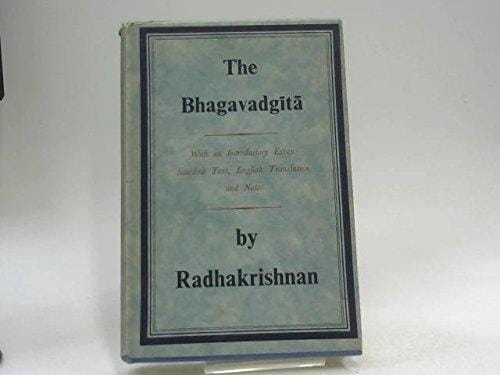
The focus on moral principles, discipline and character is further reinforced in Chapter 9 Verse 32 which states “All those who take refuge in Me, whatever their birth, race, gender, or caste, even those whom society scorns, will attain the supreme destination” and in Chapter 5 Verse 18 which states “The truly learned, with the eyes of divine knowledge, see with equal vision a Brahmin, a cow, an elephant, a dog, and a dog-eater”. These counter narratives have been used by many commentators, who rejected the caste system - due to their education and social upbringing, to argue that linking Gita’s teachings to a birth-based social hierarchy was in fact a perverse distortion of Gita’s message. For example, In his commentary on the Gita Dr. S. Radhakrishnan – the former President of India, interprets the caste system not as a rigid, birth-based hierarchy, but as a flexible social organization based on function, temperament, and quality. He argues that the Gita supports a functional division of labor designed to promote social harmony and individual spiritual growth, rather than a hereditary caste system.
The Bhagavad Gita, unlike the Torah, Bible or the Quran, is not claimed to be a ‘revealed text’ – revealed to man by a divine and omnipotent god. It therefore needs to be viewed as the product of human thought and spiritual seeking conditioned by society with room for interpretation. It is a living and dynamic response of an advanced mind (or minds) seeking ways to end human suffering and contradictions within a given social context at a particular period in history. It must never be used as a ‘trophy of piety’ – to be proudly displayed in living rooms. It is indisputable that – at the very least, statements in the Gita have been used (or misused) to propagate a social evil amongst us. Whether the Gita was misinterpreted and misused to support a detrimental social structure already present at the time of writing will never be known. The fact that it can be used as a double-edged sword in this respect must be acknowledged by all of us who value Hinduism and have chosen to live by its profound teachings.
On balance, the Gita, if viewed as a guide, is a profound inclusive and inspiring spiritual text. On the other hand, if the Gita and its parent source – the Mahabharata, are viewed as a historical social chronicle there is no doubt that they represent a primitive society where caste boundaries were powerful, discriminatory and often unforgiving. Such an interpretation of humanity is irrelevant, outdated and deserves to be rejected by all right-thinking people. Proselytism - a frequent complaint amongst Hindu and Buddhist groups, does not take place in a vacuum and cannot be curtailed if such orthodoxies - even when rooted in sacred texts, are not rejected categorically.
The views expressed in this article are those of the author and do not reflect the views of the University of Manchester on the subject