By M.R. Narayan Swamy
AFP photographer R. Raveendran and I were in a taxi in the Tamil Tigers-held zone of Sri Lanka’s Batticaloa district in the mid-1990s when a young man with an AK-47 slung over his shoulder emerged from behind a tree and waved us down.
When we said we were headed to Vakarai to try to meet Vinayagamurthy Muralitharan alias Karuna, the LTTE’s powerful eastern regional commander, he let us proceed. But he told a teenager to jump into the front of our cab.
After realising we were journalists from New Delhi, the 15-something chatted with us non-stop, now and then accusing India of “wrongly” accusing the Liberation Tigers of Tamil Eelam (LTTE) of killing former Prime Minister Rajiv Gandhi.
Some 15 minutes later, half a dozen LTTE guerrillas, none of them visibly armed, stopped us. When we enquired if Karuna was at his hub, they gestured us to direct the question to a stern-looking man who was obviously their in-charge.
Before we were allowed to drive on, the group leader called the teenager out of the car, took him aside, and whispered something in his ear. The boy nodded.
We don’t know what was conveyed, but the boy clammed up completely from then on. He would not utter a word. He refused to answer even innocuous queries. He spoke only once to direct the Tamil taxi driver to the local LTTE office.
Knowing the LTTE’s paranoia, we could surmise what must have been instructed to the teenager that forced a dramatic U-turn in his talkative personality: The two men are Indians, they may be spies!
It was a moment when I realized what a chilling difference the calculated and cold-blooded assassination of Rajiv Gandhi had made to the LTTE, a catastrophic killing that majorly contributed to the ultimate destruction of the Tamil Tigers and the annihilation of its top leadership.
Many people have asked me: What if the Tigers had not killed Rajiv Gandhi? What if India had remained largely sympathetic to the LTTE cause? Would the LTTE’s trajectory have been very different?
I am no astrologer, and I could never provide definitive answers to those questions. But I am certain that the assassination of the Indian leader at an election rally near Chennai triggered a radical change in the Indian state’s assessment of the Tamil Tigers — in a manner Velupillai Prabhakaran could never have imagined.
In retrospect, there were three major fallouts of the May 21, 1991, assassination.
One. Prabhakaran and his intelligence chief, Pottu Amman, may have inferred there would be consequences to pay, but they were somehow confident the killing could never be traced to them. They kept such a lid on truth that they lied about it to even Anton Balasingham, supposedly Prabhakaran’s confidant.
Unfortunately for Prabhakaran and Pottu Amman, Indian investigators did a thorough job that firmly exposed the LTTE’s hand in the ghastly crime, leading to a legal ban on the group that continues to this day.
Two. The most unexpected assassination brought about a complete change in the way the Indian security services handled the Tamil Tigers. From that point, the LTTE could expect no sympathy, irrespective of whichever party governed India.
Three. As a result of the above two, Rajiv Gandhi’s killing, after a while, Prabhakaran’s denials of involvement had no takers, even within the outfit – eroded whatever sympathy the Tigers enjoyed in Tamil Nadu, except in the scattered ranks of Tamil radicals. The grotesque murder sparked revulsion among most Tamils in India, Sri Lanka, and beyond.
The assassination led to a sweeping crackdown on the decades of carefully laid LTTE network in Tamil Nadu, destroying a vital backyard that was so important for the Tamil armed struggle. Its repercussions became evident as the LTTE’s war neared its final years, when virtually all sea links involving the Tigers were choked between Tamil Nadu and Sri Lanka with disastrous results.
Indian security agencies played havoc with the LTTE, repeatedly infiltrating its ranks.
A laptop bought by LTTE sympathisers in the UK for Prabhakaran’s exclusive use was covertly modified in such a way that every mail he received or sent in the supposedly secure system could be read in Chennai.
Conversations over satellite telephones between LTTE leaders from their secret lairs in Sri Lanka and their representatives or backers abroad, including in the West, were monitored in southern India.
LTTE’s secret codes based on Tamil alphabets – which were of very high quality – were frequently (but not necessarily always in time) broken by Indian agencies.
When Sri Lanka asked Norway to play peacemaker, the Indian government of Atal Bihari Vajpayee was intimately, though covertly, involved in framing the ceasefire agreement. This was hinted at to the LTTE, but India refused to lift the ban on the Tigers.
When Karuna split from the LTTE, and the ferocious Tigers hunted their former comrade across Sri Lanka, Indian intelligence agencies provided him sanctuary until he could safely return to the island nation.
And when the LTTE’s final moment reckoning came in 2009, the most powerful person in India was Sonia Gandhi, a woman Prabhakaran had callously widowed in May 1991.
In sum short, the assassination of Rajiv Gandhi was a monumental blunder from every angle, which an overconfident Prabhakaran ordered in the obvious mistaken notion that it would probably pass off as another killing and would soon fade into history. It was a calamitous miscalculation.
This was also a result of Prabhakaran’s limited worldview, having dealt until then only with Tamil Nadu politicians and officials and with only a limited understanding of how the Indian state functioned.
The one man who realized what a folly Prabhakaran had committed vis-à-vis Rajiv Gandhi was the London-based Balasingham, who told all those whom he trusted that the assassination was “an act of madness” and “a complete disaster”. Prabhakaran and Pottu Amman later confessed the truth to him.
It is not without reason that Balasingham, without any authorization from the LTTE brass, unilaterally apologized for the Gandhi killing in July 2006, months before he passed away.
In a now famous interview to the NDTV news channel, Balasingham said: “As far as that event (assassination) is concerned, I would say it is a great tragedy, a monumental historical tragedy for which we deeply regret and we call upon the government of India and people of India to be magnanimous to put the past behind and to approach the ethnic question in a different perspective.”
The apology, however genuine, came too late. In any case, those who followed the LTTE in India knew that the statement came from Balasingham, the person, not the Tamil Tigers.
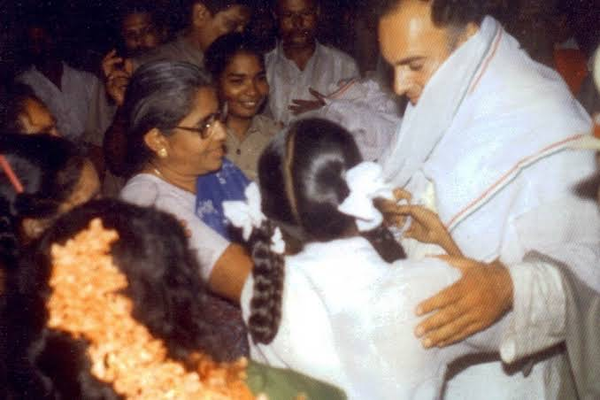
Even today, there are those in Sri Lanka who believe that Prabhakaran may have died in May 2009, but the seeds of his destruction were sown in May 1991 when the LTTE’s Dhanu exploded herself while pretending to touch the feet of an unsuspecting Rajiv Gandhi.