
By Che Ran
Sri Lanka has a strange relationship with accountability.
We adore the theatre of justice.
The press conference. The dramatic raid. The minister standing behind a microphone, sleeves metaphorically rolled up, promising to finally hunt down the untouchables. Every election, another government arrives carrying a moral broom the size of Adam’s Peak, vowing to sweep corruption out of the republic.
And every few years, we discover the same depressing truth.
The truly powerful rarely get caught.
Because real corruption is not amateur hour.
If you think sophisticated operators move money in their own names, leave tidy paper trails, or hand over briefcases under flickering street lamps, you have been watching too many bad television dramas. The serious ones hide behind offshore entities, proxies, ghost companies, old school ties, foreign intermediaries, cousins of cousins, trusted businessmen who smile politely at charity dinners while moving mountains behind the curtain.
Corruption investigations become tunnels.
Then tunnels inside tunnels.
Years pass.
Governments fall.
Files disappear. Witnesses suddenly cannot remember anything. Public anger grows tired. The headlines move on.
Eventually, Sri Lanka does what Sri Lanka does best.
We sigh.
Shake our heads.
And mutter those three national words:
“Aney… this country.”
But what if the greatest question of accountability staring at this island was never hidden?
What if it has been sitting there in plain sight for years?
A child.
A war already won.
And a question too uncomfortable for politicians to touch.
Let me say something many are too frightened to say aloud.
Ending the war was necessary.
No sane person who lived through suicide bombings, assassinations, bus explosions, fear, checkpoints, extortion, and endless funerals can deny what peace gave this country. Roads reopened. Businesses returned. Families breathed again. Children grew up not knowing the sound of bombs as ordinary background noise.
For that, Sri Lanka deserves recognition.
But victory does not grant moral immunity.
Winning a war is not a license to stop asking questions.
Governments are not crime families.
A nation cannot operate like some gangster-era syndicate where difficult decisions disappear into whispered conversations, everybody shrugs, and history is instructed to stay quiet.
Because civilized nations are not measured only by whether they win wars.
They are measured by what they are brave enough to confront afterward.
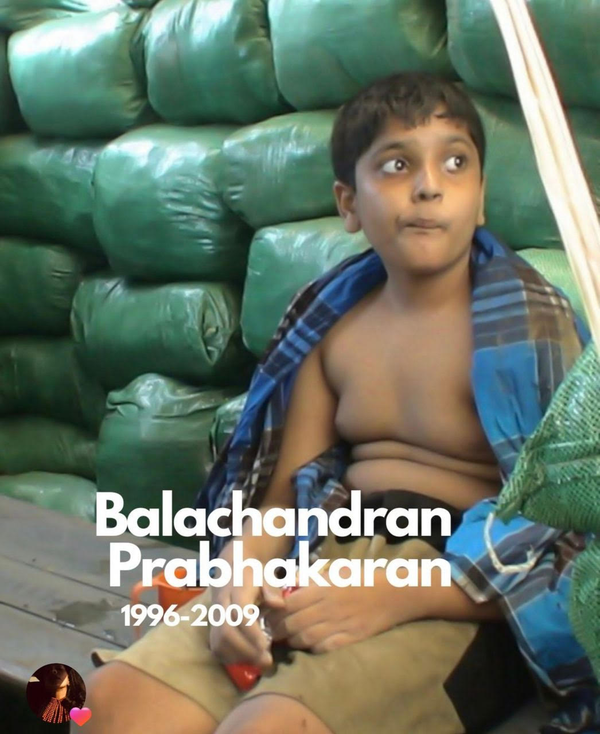
And sixteen years later, one image still refuses to disappear.
A small boy.
Alive.
Sitting quietly.
Still young enough to look frightened in the way children do when adults are speaking in rooms they do not understand.
For many Tamils, the image became something larger than politics.
Larger than ideology.
Larger than war.
It became a wound.
Not because everyone agrees on every allegation surrounding those final days — they do not.
But because the questions never truly went away.
What happened?
Who knew?
Was everything done lawfully?
Why has there never been a process trusted enough to answer these questions with credibility?
These are not dangerous questions.
Avoiding them is what becomes dangerous.
Because silence does not heal history.
Silence ferments.
It settles into memory.
It travels quietly from generation to generation — over dinner tables in Jaffna, Mullaitivu, Colombo, Toronto, London, and Melbourne — until grief becomes inheritance.
And inheritance becomes anger.
Sri Lanka has spent years trying to outrun its ghosts.
But ghosts are stubborn creatures.
They wait.
Sometimes history comes knocking softly.
Sometimes it arrives with international scrutiny, uncomfortable headlines, leaked reports, and foreign pressure.
And by then, countries no longer own their own stories.
Others write it for them.
That is the real tragedy.
Because Sri Lanka still has a choice.
We can continue pretending that accountability weakens nations.
Or we can finally understand the opposite.
Strong countries investigate themselves.
Strong countries ask painful questions.
Strong countries are confident enough to say:
Yes, we ended a brutal conflict. Yes, we protected the nation. But if unlawful acts occurred, we are strong enough to face them honestly.
That is not betrayal.
That is maturity.
Because patriotism is not blind loyalty to power.
Patriotism is wanting your country to become better than its worst moments.
The war ended.
Thank God it did.
But peace without truth is unfinished business.
And perhaps history is asking Sri Lanka something uncomfortable now:
Are we finally strong enough to stop being afraid?
Strong enough to stop whispering?
Strong enough to look backward so the next generation can finally move forward?
Because nations are not judged only by how they win wars.
They are judged by what they do after the cheering stops.
After the speeches.
After the victory parades.
When the smoke clears.
When the flags come down.
And history, in a much quieter voice, asks one final question:
What did you do when you finally knew enough to ask harder questions?