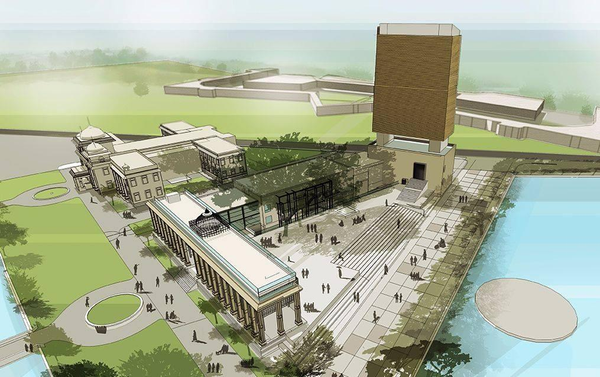
When a government builds a bridge, the measure of its generosity is not the span of the arch but the lives it connects. By that measure, the Thiruvalluvar Cultural Centre — an eleven-storey edifice standing at the waterfront of Jaffna, conceived and constructed as a government-to-government gesture of friendship between India and Sri Lanka — is among the most consequential gifts this province has ever received.
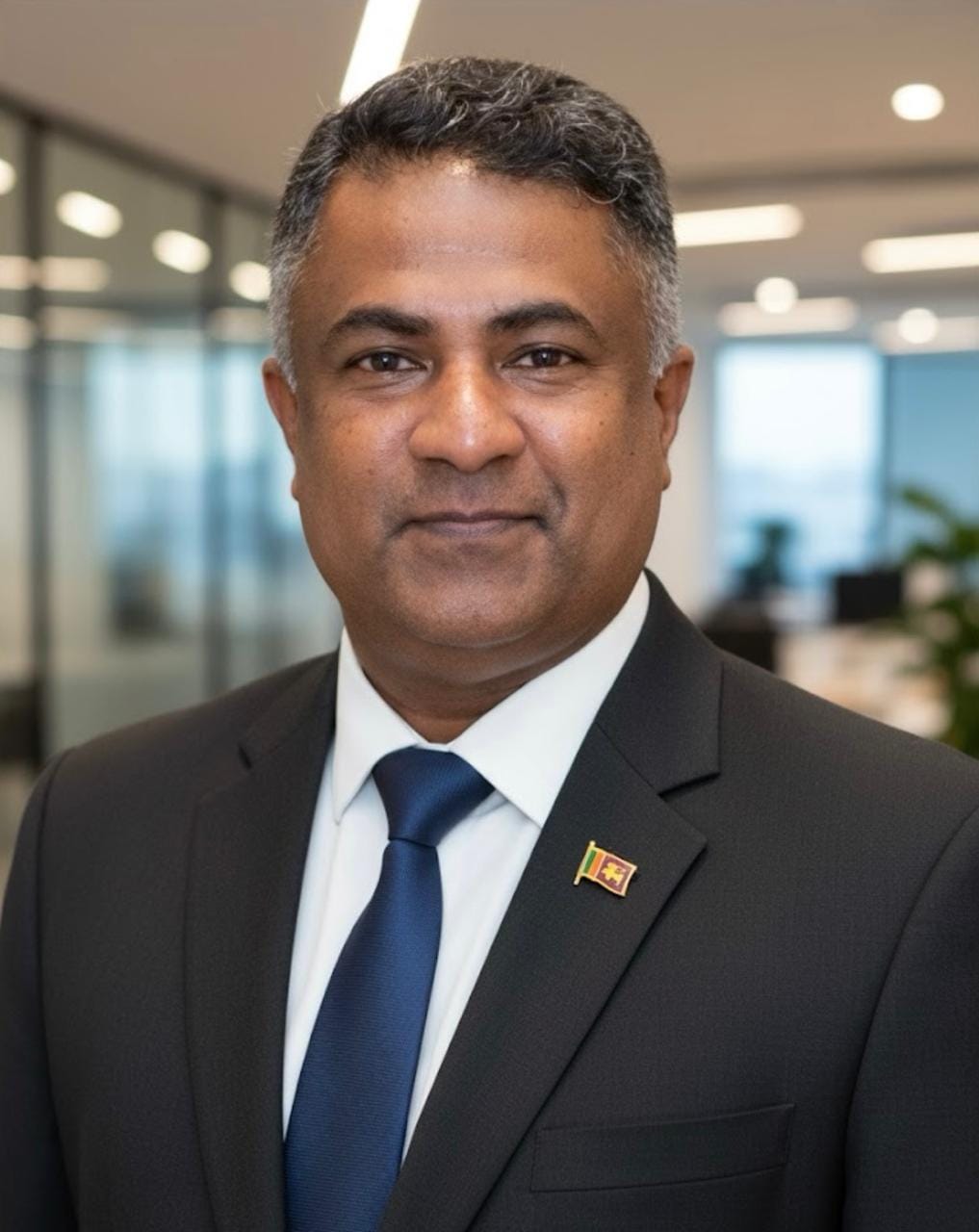
This is my third submission on the subject. As Governor of the Northern Province, I set out the first in the joint management committee : a detailed accounting of how the existing provincial cadre could orient and service this facility from day one, without waiting for new appointments or fresh budgets.
My second submission were directions envisaging a graduated programme of activations: the waterfront terraced and animated, a floating platform for musical performances on the water, the road in front transformed into a hawker street and exhibition ground, the building’s steps and forecourt and steps becoming a gallery where young artists could show and sell, floors inside curated upward from instruction to exhibition to personal collections on loan.
This third submission, addressed to the Indian High Commissioner, proposed the architecture of permanence: what should endure for the next generation.
At a moment when the long-term institutional future of the Centre remains under discussion, it may be prudent for India to directly oversee , mentor and operate the facility in accordance with the standards and vision reflected in its established cultural centres in India and elsewhere, and to develop this unique cultural centre into an iconic institution secured financially and intellectually.
The World’s Great Cultural Institutions: A Vision for Jaffna
Across the globe, the greatest cultural institutions — from the Metropolitan Museum and the Uffizi, to Carnegie Hall and the Sydney Opera House, to the Forbidden City’s Palace Museum and Singapore’s Esplanade — are not merely buildings. They are living declarations of a civilization’s identity, memory, and creative spirit; covenants between a community and its artists; and proof that a people’s story, told through art and performance, can move the world. The Jaffna Cultural Centre must create precisely this — a space where performing and visual arts traditions are not merely preserved but celebrated, and given a permanent home worthy of its depth.
A Hybrid Management Philosophy
The institutions that have shaped modern India’s intellectual and cultural life offer us three distinct archetypes, each applicable here.
PILLAR I — Learning & the Arts- Modelled on Shanti Niketan
PILLAR II — Dialogue & Research- Modelled on the IIC
PILLAR III — Living Ecosystem- Modelled on the IHC
Shanti Niketan’s ethos of immersive, holistic education in the arts; the India International Centre’s tradition of serious intellectual and policy discourse; and the India Habitat Centre’s genius for creating a self-sustaining organism of footfall, commerce, and culture — these three, synthesised into a single governance philosophy, give us our template.
But a philosophy only lives through people. At every level of this management structure, we must make it standard practice to draw in centres and persons of excellence — from Sri Lanka, from the diaspora, and from the wider world. Renowned guest scholars should occupy the seminar rooms. Celebrated curators should shape the gallery floors.
Distinguished jurists and diplomats, whether from Colombo or Cambridge, should share platforms with their Jaffna counterparts. The Governing Board and its three specialist councils must themselves reflect this aspiration: not a closed bureaucratic circle, but an open, rotating fellowship of the best minds available to us.
Drawing on excellence: Each council seat — for Higher Learning, for Arts and Heritage, for Policy and Governance — should carry a mandate to invite at least one visiting fellow or practitioner of international standing per year, bridging local expertise with global perspective.
Anchoring with India’s Elite Institutions — and the World Beyond
The Indira Gandhi National Open University can establish a study and examination hub here, making this a gateway for Northern Province students to access Indian higher education. But the digital library and multimedia infrastructure need not serve only IGNOU’s syllabi — they become, equally, a portal through which guest lecturers from MIT OpenCourseWare, the London School of Economics, or the University of Peradeniya can teach live or on-demand to students connected from Jaffna.
Drawing on excellence: The distance learning hub should actively commission visiting online masterclasses from distinguished Sri Lankan academics in the diaspora — economists, scientists, legal scholars, technologists — making the Centre a point of reconnection between the Northern Province and its global community.
The IIMs can offer executive programmes and entrepreneurship incubation for civil servants and business leaders from across the North — co-facilitated by practitioners: a Sri Lankan entrepreneur who has built a regional company, a Singaporean policy architect, a Tamil Nadu agri-tech founder. The classroom comes alive when lived experience walks through the door.
Drawing on excellence: Each executive cohort should include at least one practitioner-in-residence drawn from Sri Lanka’s private sector or its global diaspora, to ground theory in regional reality.
The National Judicial Academy and the National Law School of India University together can transform the Centre into a serious venue for continuing legal education. Comparative constitutional law is most powerfully taught when it is genuinely comparative — jurists from South Africa, Canada, and the UK, whose constitutional settlements carry hard-won lessons on pluralism, devolution, and transitional justice, should sit alongside Sri Lankan and Indian judges in this very auditorium.
Drawing on excellence: Annual legal dialogues should feature sitting and retired judges and constitutional scholars from at least three jurisdictions, positioning Jaffna as a serious node in the global conversation on law and governance.
The Gujarat Forensic Sciences University fills a crying need with certificate courses in forensic science, cybersecurity, and crime scene management. Interpol training modules, visiting forensic pathologists from regional partners, and internationally certified instructors can all be drawn to a facility that signals its seriousness.
Drawing on excellence: Forensic and technical courses should be co-delivered with visiting specialists from regional law enforcement academies and international bodies, ensuring students in Jaffna are trained to globally recognised standards.
For the performing arts, Kalakshetra and the NCPA in Mumbai provide the institutional anchors. But the auditorium and instructional wing must pulse with a wider ambition — a residency programme drawing from Sri Lanka’s own underserved talent pool, from the Tamil diaspora in Europe, Canada, and Australia, and from the broader South and Southeast Asian arts ecology. Partner institutions in India and beyond should offer time-share arrangements on rotation — specialised faculty, curators, and practitioners cycling through the Centre on structured secondments, so that expertise is not merely visited but embedded.
Drawing on excellence: A permanent Artist-in-Residence programme — open to local, national, and international applicants — should run year-round, ensuring the Centre is always host to at least one working artist whose practice is visible and accessible to the public.
The Jaffna Dialogue — the recurring policy forum convened with ICWA and ORF — must resist insularity. Maritime security, development finance, climate adaptation, post-conflict reconstruction: these are global subjects. A former UN Special Rapporteur, a Pacific island climate negotiator, a World Bank economist: the Jaffna Dialogue should, over time, become a destination that serious people choose to attend.
Drawing on excellence: Each edition of the Jaffna Dialogue should feature a keynote from a figure of international standing — signalling that this province is not a recipient of global conversations, but a participant in them.
The Sacred Link: A Fourth Pillar
There is a dimension of this Centre’s potential that no purely academic or policy framework can capture: the living civilisational inheritance of Hindu ritual, scripture, and practice — an inheritance that is simultaneously our most intimate possession and the common patrimony of tens of millions across the world.
The Thiruvalluvar Cultural Centre becomes the institutional home of The Sacred Link — a global broadcast and e-learning ecosystem that unites temples, Pathashalas, and universities in a single, living digital community, in formal partnership with temples.
FOURTH PILLAR — The Sacred Link: Global Broadcast & E-Learning Ecosystem
TIER I — LAY: Accessible introduction to ritual meaning, festival cycles, and devotional practice
TIER II — CLERGY: Structured instruction for temple priests and Pathashala students in liturgy and Agamic tradition
TIER III — SCHOLARS: Advanced engagement with Sanskrit and Tamil sacred texts and comparative theology
The operational model is simple. Temples — beginning with shrines in Sri Lanka, expanding to partner institutions in Tamil Nadu, greater India, Malaysia, Singapore, Mauritius, the United Kingdom, and beyond — record their rituals using a standardised protocol. That raw footage flows to a central production team housed at the Centre itself, where it is processed: subtitled in Tamil, transliterated into accessible script, annotated with liturgical context, and formatted for broadcast. The result feeds a 24/7 channel — the sacred calendar of living Hinduism, uninterrupted, available to anyone on earth with a screen.
This is not merely an archival exercise. It is an act of civilisational continuity. The Tamil diaspora in Toronto or Hamburg — a second-generation child who has never stood inside a Jaffna temple — can watch the Thiruvannamalai deepam or the Nallur chariot festival in real time, with the understanding to know what they are witnessing. A priest in training in Kuala Lumpur can follow a master officiant in Colombo. A scholar in Chicago can access a Pathashala lesson in Jaffna that would otherwise remain confined to a single courtyard.
Drawing on excellence: The Sacred Link must actively commission contributions from the foremost living authorities in Agamic tradition, Shaiva Siddhanta, and Sanskrit scholarship — from the Dharmapuram Adheenam, from the Kashi Vidwat Parishad, from Hindu chairs at universities in the United Kingdom and North America — ensuring that the highest levels of scholarly and ritual excellence are represented alongside the everyday devotional life of ordinary temples.
The production hub at the Centre creates skilled employment — video editors, subtitle translators, liturgical annotators, broadcast engineers — positions that are meaningful, generative, and deeply rooted in the culture they serve. In time, The Sacred Link becomes the world’s most comprehensive living archive of Hindu ritual practice — not a museum piece, but a breathing, daily-updated record of a tradition that is very much alive.
Sustaining the Vision: A Multi-Tiered Funding Strategy
A vision without financing is a wish. The Centre’s financial sustainability must rest on three pillars simultaneously. Federal Indian schemes — SWAYAM and NEAT for distance learning, IGNCA grants for cultural archives, ICCR funds for seminars and residencies — provide the foundation.
Tamil Nadu can fund Tamil language chairs and heritage tourism initiatives. Gujarat’s Sister State MoU opens a channel for forensic sciences scholarships. The Sacred Link itself becomes a funding asset: subscription tiers, diaspora temple partnerships, and university licensing agreements generate recurring revenue that flows back into the Centre’s operations.
Major Indian corporates with a Sri Lankan footprint — L&T, Tata, Lupin, Ashok Leyland — should endow specific seats, auditorium sections, or library wings. The Tata Trusts and Infosys Foundation are natural partners for a Technocrat Scholarship programme. And the Tamil diaspora — in Toronto, London, Paris, Sydney — represents an enormous, largely untapped reservoir of both philanthropic capital and human excellence. A formal Friends of Thiruvalluvar network can channel both.
Drawing on excellence: A Diaspora Fellows scheme — bringing back Sri Lankan Tamil professionals from medicine, law, technology, and the arts for short-term teaching or curatorial residencies — would simultaneously enrich programming and begin to rebuild the human connections that decades of conflict severed.
A Sunset Clause for Self-Reliance
Every partnership agreement must carry a built-in, time-bound transfer of stewardship to Sri Lankan hands. India’s institutions are the catalyst, not the permanent engine. The provincial cadre of the Northern Province — already in post — must become the ultimate custodians of what is built here.
We live in an era when almost everything we wish to offer — education, culture, dialogue, expertise, the sacred — is simultaneously global, virtual, and at arm’s reach. The visitor to Jaffna who walks into this Centre on a Saturday morning might attend a lecture delivered live from Chennai, watch a film curated by a diaspora filmmaker in Melbourne, browse an exhibition designed in collaboration with a museum in Amsterdam, and end the evening watching a Bharatanatyam recital — while upstairs, a production team processes footage of a dawn puja from a temple in Batticaloa, ready for a devotee in London to watch before breakfast.
That is what is possible, if we build for it.
The Thiruvalluvar Cultural Centre is not a building. It is, if we choose to make it so, a living institution — restless, generative, magnetic to excellence wherever it resides, and indispensable to the life of Jaffna and its global community for decades to come.
I request the Government of India’s support in deploying these partnerships and accessing these diverse funding streams. The structure stands. Now let us give it a soul.
The author served as Governor of the Northern Province of Sri Lanka. This piece draws on three formal submissions regarding the Thiruvalluvar Cultural Centre.