

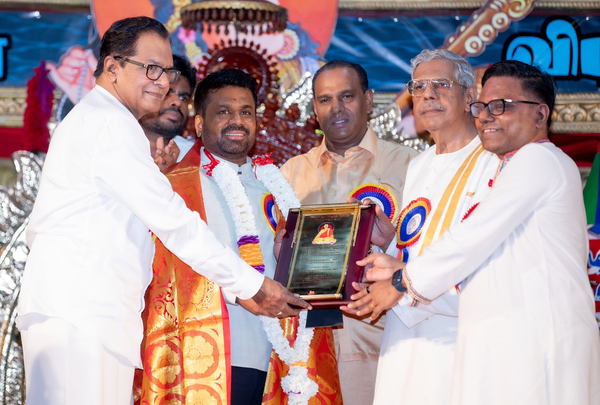
President Anura Kumara Dissanayake accepted an award from one of Sri Lanka’s leading Tamil literary organizations on Sunday, using the occasion to pledge his commitment to eradicating racism and building lasting ethnic reconciliation — but the honor also triggered immediate praise alongside sharp controversy, with critics questioning both the president’s record and the decision to confer such recognition at a time when many longstanding Tamil grievances remain unresolved.
Mr. Dissanayake was presented with the Kamban Fame Award at the closing ceremony of the All Ceylon Kamban Kazhagam’s annual Kamban Festival, held at the Ramakrishna Mission Hall in Wellawatte, Colombo.
The award, conferred by the Kamban Kazhagam — a body dedicated to celebrating the Tamil classical literary tradition — was framed by its organizers as a gesture of interethnic goodwill toward a president who has spoken frequently of national unity.
Accepting the honor, Mr. Dissanayake offered his statement on reconciliation, describing it as the defining political mission of his administration.
“In Sri Lanka, our political agenda is to defeat racism and fully establish reconciliation,” he said. “The path toward achieving that reconciliation is very long. But we will never hesitate in pursuing it. We will achieve it.”
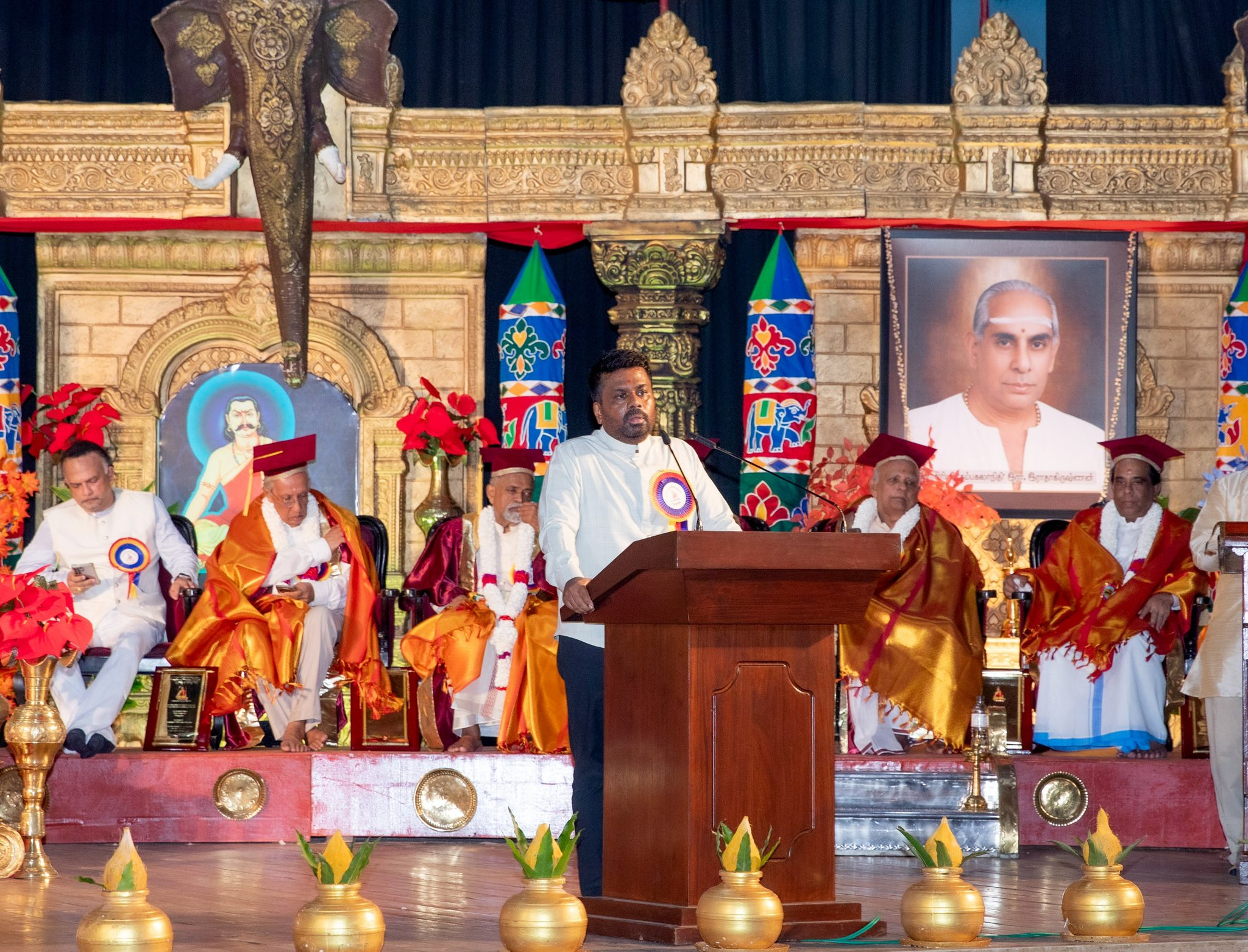
He invoked the memory of the late Tamil political leader R. Sampanthan, recalling that Sampanthan had told him that genuine pride in Sri Lankan citizenship would come only when Tamils were treated as equals in every sphere of national life. “That is an absolutely correct view,” Mr. Dissanayake said. “We will certainly make that a reality.” He also signaled support for greater regional administrative autonomy, arguing that communities in each province should be empowered to manage their own affairs.
THE KAZHAGAM UNDER FIRE
Sections of the Tamil community and civil society organizations accused the Kamban Kazhagam of squandering its moral authority by conferring cultural recognition on a head of state who has yet to take meaningful action on any of the Tamil community’s core political demands. Several commentators described the gesture as nakedly opportunistic — a bid for government favor or institutional visibility dressed up as cultural bridge-building.
A Tamil literary enthusiast, who wished not to be named, questioned the decision by one of the country’s influential — and at times controversial — Tamil cultural organizations to honor the president at this stage of his administration.
‘He has not released political prisoners, repealed the Prevention of Terrorism Act, or meaningfully addressed the issue of military-occupied Tamil lands,’ the individual said. ‘So one must ask what exactly is being recognized here — concrete progress, or rhetoric alone?’
RECOGNITION AS ENCOURAGEMENT, NOT ENDORSEMENT
Offering a contrasting perspective, a supporter of the Kamban Kazhagam said the award was intended not as an endorsement of completed political achievements, but as recognition of a southern leader who, in their view, had publicly articulated a vision of equality and reconciliation that many Tamil communities have long sought.
“If Tamil people are viewed not through the lens of racism, but as equal citizens of this country — if their just and legitimate aspirations and rights are recognized, accepted and embraced — then yesterday clearly demonstrated to Sinhalese leaders and the broader public how deeply Tamils are capable of respecting and honoring such southern leaders,” the supporter said.
TAMIL DEMANDS LEFT UNMET
The controversy surrounding the award underscored a broader and deeply rooted skepticism among many Tamil rights advocates toward reconciliation rhetoric from Colombo, regardless of who delivers it.
Among the criticisms that circulated widely on social media was a Facebook post by social worker Rajkumar Rajeevkanth, who argued that symbolic recognition should follow substantive political action rather than precede it.
He outlined a series of longstanding demands that remain unresolved.
Those included the release of Tamil political prisoners, repeal of the Prevention of Terrorism Act, resolution of military occupation of civilian lands in areas such as Valikamam North and Thaiyiddy, credible investigations into mass graves, including Chemmani, answers for families of the disappeared, land rights for Hill Country Tamils, removal of constitutional structures seen by critics as privileging Buddhist majoritarianism, and meaningful political power-sharing.
“Only when such promises are fulfilled,” he wrote, “will we too gladly attend award ceremonies and applaud with genuine joy.”
Other critics questioned whether the literary organization’s decision reflected broader Tamil public sentiment, arguing that cultural symbolism alone could not substitute for unresolved structural and political grievances.
For Mr. Dissanayake, who came to power promising systemic reform, the appearance at the Kamban Festival may represent an effort to build trust across ethnic divides. But reactions from segments of Tamil civil society suggest that many remain unconvinced by rhetoric absent concrete policy changes.
Key grievances remain unresolved. Thousands of Tamil families continue to seek answers about relatives who disappeared during and after the civil war. Military control over portions of civilian land in the North remains a source of anger. The Prevention of Terrorism Act, long criticized by human rights groups, remains in force despite repeated reform pledges.
None of those issues was directly addressed in Mr. Dissanayake’s speech at the Ramakrishna Mission Hall.
The All Ceylon Kamban Kazhagam was founded in Jaffna in 1980 by Kambavarithi Ilankai Jeyaraj, a prominent Tamil literary and religious orator known for his influential role in promoting Tamil language, literature, and classical cultural traditions in Sri Lanka.