

Sri Lanka’s State Tamil Daily Editor Suspended Amid Major Fraud Probe

Sri Lanka’s State Tamil Daily Editor Suspended Amid Major Fraud Probe


Share this post

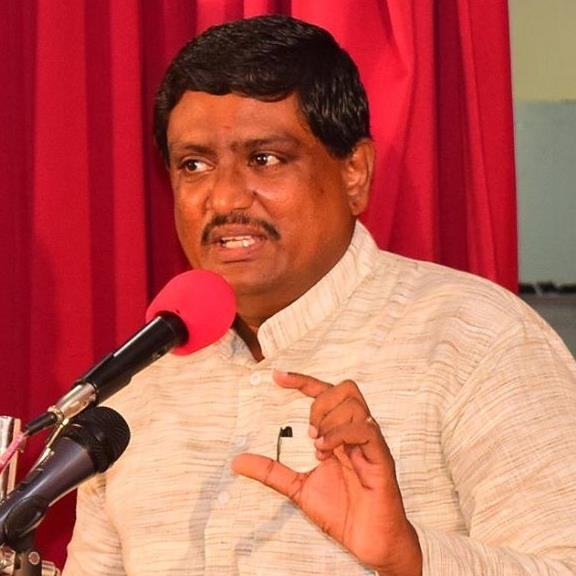
R. Senthil Velavar, the Editor-in-Chief of Sri Lanka’s state-run Tamil daily Thinakaran, was suspended by Lake House management this week over allegations of financial misconduct, according to sources within the institution.

The suspension follows an internal investigation into claims that Senthil Velavar misappropriated advertising revenue by personally collecting payments for advertisements but, instead of publishing the paid advertisements as contracted, allegedly replacing them with news content while retaining the funds outside official channels.

Sources further allege that, on certain occasions, he collaborated with a layout artist to produce fabricated newspaper pages featuring advertisements that were never published in the official print edition. These pages were reportedly presented to advertisers who were unlikely to independently verify publication, enabling the alleged misappropriation of associated payments.

Investigators reportedly estimate that approximately Rs. 6.5 million may have been fraudulently diverted within an eight-month period alone, while further inquiries are examining whether similar irregularities occurred over a longer timeframe.

Lake House, Sri Lanka’s state-owned media institution, is also expected to file a formal complaint with the Criminal Investigation Department (CID) as the investigation progresses.

The suspension has sparked sharp reactions from sections of Sri Lanka’s Tamil literary and media communities, including prominent writer and journalist N. Saravanan, who publicly claimed that complaints supported by substantial evidence had been raised with authorities more than a year ago.

In a strongly worded social media statement, Saravanan alleged that Senthil Velavar’s tenure severely damaged the credibility of the national Tamil newspaper, accusing him of corruption, fostering a toxic newsroom culture, and using pressure, controversy, and institutional instability to shield himself from scrutiny.

He further alleged that certain literary and political figures had exploited their relationship with Senthil Velavar to gain disproportionate media exposure.

Saravanan described the suspension as long overdue and expressed hope that the move would provide relief to Thinakaran employees while ultimately benefiting its readership.


Share this post

Be the first to know

Join our community and get notified about upcoming stories

Subscribing...
You've been subscribed!
Something went wrong
The Real Battle for Credibility

The Real Battle for Credibility

This month, I was invited to speak at the second Sri Lanka–India Media Friendship Association (SLIMFA) Media Fest in Colombo, on the theme “Trust, Truth and the Battle for Credibility.” Illness prevented me from attending. I have chosen instead to publish the thoughts I had prepared as this month’s editorial, because the issues they address extend far beyond a conference hall. Where I Stand I come from Northern Sri Lanka, a region devastated by nearly three decades of civil war. My entire chi


Aruliniyan Mahalingam

Aruliniyan Mahalingam

Rights Group Accuses Sri Lanka of Obstructing Chemmani Mass Grave Investigation

Rights Group Accuses Sri Lanka of Obstructing Chemmani Mass Grave Investigation

For three decades, the state’s answer to the families of Jaffna’s disappeared has been that it does not know. A report released this week argues that it has always known — and has spent thirty years making sure that nothing could be done about it. The report, published by the International Truth and Justice Project (ITJP), a London-based group that has documented Sri Lankan war crimes since 2013, lands as excavators returned to the Chemmani salt flats on Tuesday to resume a dig that has already


Our Reporter

Our Reporter

Should Sanctions Extend to a General's Memoir?

Should Sanctions Extend to a General's Memoir?

By M.R. Narayan Swamy Realising that the war for Tamil Eelam would need a constant supply of weapons, Velupillai Prabhakaran set up in 1985 Kadal Pura, a modest sea wing in the Liberation Tigers of Tamil Eelam (LTTE). Over the years, it grew into the formidable Sea Tigers, which threatened to overwhelm Sri Lanka’s navy. Once the fourth and final Eelam War resumed in August 2006, it became payback time. The Sri Lankan Navy rapidly sank in 2007 the LTTE’s awesome warehouse ships, left and right.


M.R. Narayan Swamy

M.R. Narayan Swamy

The Missing Half of Sri Lanka's Post-War Recovery

The Missing Half of Sri Lanka's Post-War Recovery

By Jeevan Thiagarajah Seventeen years after Sri Lanka's civil war ended, the country has run one of the world's more closely studied reintegration experiments — and left another almost entirely undone. On one side, 12,196 former LTTE combatants passed through a state-run rehabilitation programme that concluded in 2021. On the other, hundreds of thousands of state security personnel — soldiers, sailors, airmen, and police who fought the same war — returned home to no equivalent programme at all.


Jeevan Thiyagaraja

Jeevan Thiyagaraja