

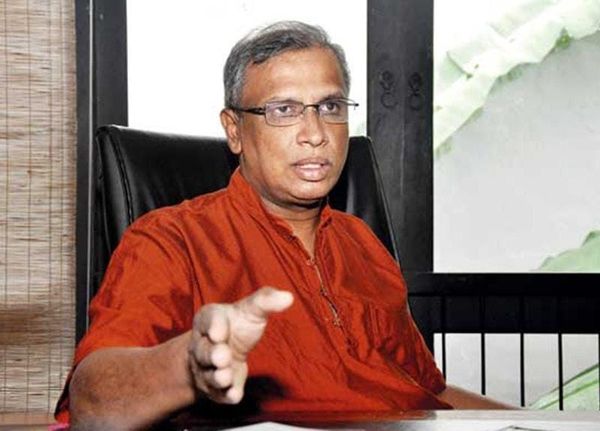
Sumanthiran Shares Kamal Haasan Video Criticizing India’s Central Government and Backing DMK, Stirring Debate

Sumanthiran Shares Kamal Haasan Video Criticizing India’s Central Government and Backing DMK, Stirring Debate


Share this post

JAFFNA, Sri Lanka — A video by actor-turned-politician Kamal Haasan sharply criticizing India’s central government and calling for the re-election of the Dravida Munnetra Kazhagam (DMK) in Tamil Nadu was shared on social media by M. A. Sumanthiran, prompting debate over whether the move constitutes an official endorsement or simply a personal post.

In the video, Mr. Kamal Haasan frames the Tamil Nadu election as a choice between decisions being made in Chennai or in New Delhi — a critique of the central government led by the Bharatiya Janata Party (BJP). He urges voters to support the DMK alliance led by Chief Minister M. K. Stalin, arguing that the party’s governance model has delivered welfare and social progress.

Mr. Kamal Haasan’s remarks draw on the legacy of Dravidian politics, emphasizing federalism and regional autonomy, and implicitly criticizing what he portrays as centralizing tendencies in New Delhi.

Mr. Sumanthiran, the acting general secretary of the Ilankai Tamil Arasu Kachchi (ITAK), shared the video without additional comment, but the move has sparked mixed reactions among party supporters and observers.
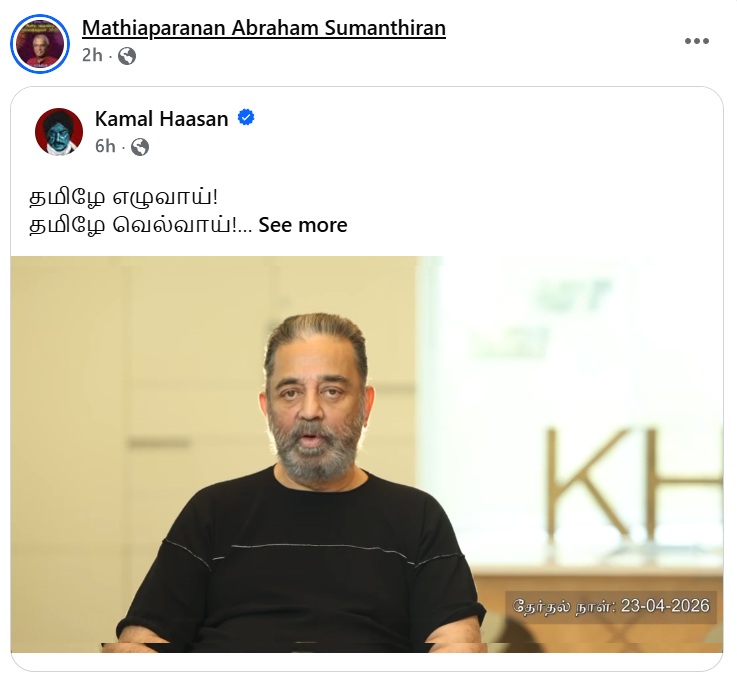
A screenshot of a social media post shared by M. A. Sumanthiran featuring a video by Kamal Haasan backing the Dravida Munnetra Kazhagam and criticizing India’s central government. The post has since been deleted.

Some members and affiliates, speaking to Jaffna Monitor, said the post could be interpreted as a political endorsement of the Dravida Munnetra Kazhagam alliance in a neighboring country’s election — a move they described as inappropriate and potentially counterproductive for a Sri Lankan party.

Others, however, said the post should not be overinterpreted.

Neither M. A. Sumanthiran nor the ITAK has issued an official clarification on why he chose to share a video critical of India’s central government.

Sivapatham, 62, a retired teacher in Jaffna and a long-time ITAK supporter, told Jaffna Monitor that, ultimately, it is India’s central government that has the ability to influence outcomes affecting Sri Lankan Tamils. “Whether one agrees with it or not, only the central government in New Delhi has the power to act,” he said. “Governments in Tamil Nadu — whether led by the DMK or any other party — can voice concerns, but they do not have the authority to act in another country.”

He questioned the political judgment behind the move. “Mr. Sumanthiran, as the acting general secretary and a leading figure in the party, is widely seen as shaping its direction. Why, then, take a step that could be seen as antagonizing the central government?” he said.

Editor’s Note: After the publication of this report, the social media post shared by M. A. Sumanthiran was removed from his page. There is no indication that the removal was related to this report, and it is not immediately clear when or why the post was taken down.


Share this post

Be the first to know

Join our community and get notified about upcoming stories

Subscribing...
You've been subscribed!
Something went wrong
Sri Lankan Parliament Suspended After Chaotic Protest Over Judiciary Debate

Sri Lankan Parliament Suspended After Chaotic Protest Over Judiciary Debate

COLOMBO, Sri Lanka — Sri Lanka’s Parliament descended into disorder on Tuesday when opposition lawmakers protested the government’s refusal to allow an urgent debate on persistent judicial vacancies and a contentious proposal to extend the retirement age of senior judges, prompting the Speaker to suspend proceedings for 10 minutes. The confrontation began after opposition legislators, led by Ajith P. Perera of the Samagi Jana Balawegaya, pressed for immediate discussion of long-unfilled positio


Our Reporter

Our Reporter

U.S. Embassy Announces Transfer of 10 Helicopters to Sri Lanka Air Force
President Anura Kumara Dissanayake attends the induction of TH-57 Sea Ranger helicopters to the Sri Lanka Air Force alongside senior U.S. and Sri Lankan defense officials at Ratmalana Air Force Base on June 23, 2026.

U.S. Embassy Announces Transfer of 10 Helicopters to Sri Lanka Air Force

RATMALANA, Sri Lanka — The United States has transferred 10 TH-57 Sea Ranger (Bell 206) helicopters to the Sri Lanka Air Force, according to a press release issued by the U.S. Embassy in Colombo on Tuesday. The handover took place at Ratmalana Air Force Base in the presence of President Anura Kumara Dissanayake, U.S. Pacific Air Forces Commander General Kevin Schneider, and U.S. Assistant Secretary of State Paul Kapur, the embassy said. According to the U.S. Embassy, the helicopters were trans


Our Reporter

Our Reporter

Ex-Militants in Europe Question Maulana’s Easter Bombings Claims

Ex-Militants in Europe Question Maulana’s Easter Bombings Claims

By M.R. Narayan Swamy When Sivanesathurai Chandrakanthan alias Pillaiyaan was first told that his former aide Azad Maulana was planning to stir up some trouble from Europe, the former’s instant reaction was: “Really? What could it be about?” Pillaiyaan, a former chief minister of Sri Lanka’s Eastern Province, could only recall the mountain of difficulties Mohammed Hanzeer Mohammed Mihilar, alias Maulana, had been in due to his own family problems. The Amparai-born Maulana had apparently


M.R. Narayan Swamy

M.R. Narayan Swamy

The Padmanabha Massacre: The Killing That Foretold a Movement's Isolation

The Padmanabha Massacre: The Killing That Foretold a Movement's Isolation

By M.R. Narayan Swamy When EPRLF leader K. Pathmanabha was gunned down with 12 party colleagues (and two Indians) in Chennai in 1990, it was a clear signal that the LTTE was set to take individual terrorism to a new level even as it waged an armed struggle in Sri Lanka. Most unfortunately, the red flag was mostly ignored by the Indian state, Tamil Nadu politicians, and the larger Sri Lankan Tamil society. Most people in the Indian establishment and among Tamil Nadu leaders viewed the cold-bloo


M.R. Narayan Swamy

M.R. Narayan Swamy