
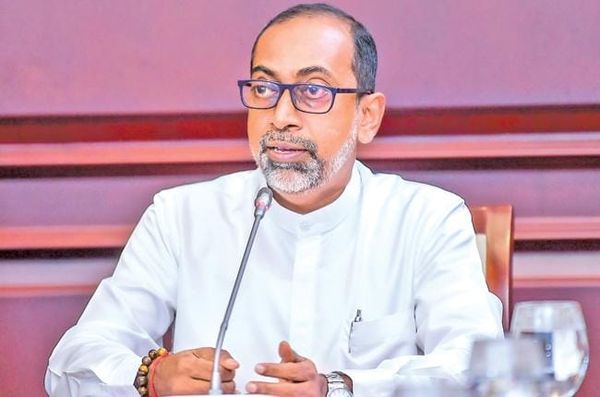
COLOMBO, Sri Lanka — The Sri Lankan government is moving to designate Vedukunari Hill, a contested site in the Nedunkerny area of Vavuniya, as a protected forest zone, a step officials say is necessary to preserve an ancient Buddhist heritage site but one that has deepened unease among Tamil political leaders over how the island’s past is being officially defined.
The issue resurfaced after the Minister of Buddhasasana, Religious and Cultural Affairs, Dr. Hiniduma Sunil Senevi, told Parliament on April 10 that religious markers found at Vedukunari Hill had been confirmed as belonging to the Buddhist faith and that a gazette notification would soon be issued as part of moves to bring the area under state protection.
“The monuments identified at Vedukunari Hill have been confirmed as belonging to Buddhism,” the minister said during a parliamentary debate. “This has been scientifically established based on cave inscriptions dating back to the 2nd century B.C.”
He also said that unauthorized construction at the site had caused significant damage to the archaeological landscape, and that the Department of Archaeology had already initiated legal proceedings over damage to antiquities and the erection of unlawful structures. Under Sri Lanka’s Antiquities Ordinance, altering, damaging or removing historical monuments is a serious offense.
Government officials have said there is no bar on religious worship at the site, so long as such activity does not damage archaeological remains. But the decision to move ahead with formal protection has alarmed critics, who say the state is treating a contested historical interpretation as settled fact.
Among those raising objections is Douglas Devananda, the former minister and secretary general of the Eelam People’s Democratic Party, who in a press release called for a fresh archaeological inquiry that would include Tamil and Muslim researchers, not only Sinhala scholars and officials.
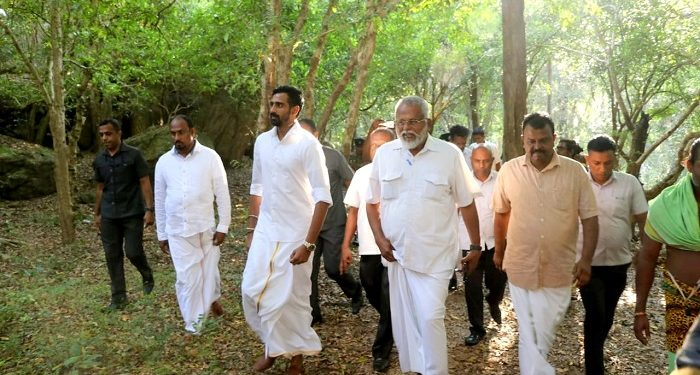
Mr. Douglas Devananda challenged the government’s characterization of the inscriptions at the site, citing Tamil historical scholarship to argue that the Brahmi cave inscriptions at Vedukunari Hill — three among fifty-four identified across the Vanni region — cannot be assigned so simply to a single religious or ethnic tradition.
Mr. Douglas Devananda also told a Jaffna Monitor reporter that he had written to President Anura Kumara Dissanayake expressing his concerns.
Drawing on the work of the Tamil historian C. Pathmanathan, Mr. Devananda said the Brahmi inscriptions found in Vavuniya District show some of the strongest evidence of Tamil linguistic influence among such inscriptions discovered in Sri Lanka. He noted that words such as “Vel,” “Velu,” “Parumakan” and “Abi” appear in these inscriptions.
He quoted one such inscription as reading: “Parumaka Asa Atheka Velasa Jaayaa Thisaaya Lene,” ('பருமக அஸ அதேக வேளஸ ஜாயா திஸாய லெணெ') which he rendered as meaning: “The cave of Thisa, the wife of Vel, who was a chief and lord of horses.”
In Sangam-era Tamil society, Mr. Douglas Devananda noted, minor rulers were referred to as “Vel” or “Velir,” and he said the same usage appears to have existed among Sri Lankan Tamils. On that basis, he argued that the inscription points to the presence of local Tamil-speaking or Naga-linked communities in the region, complicating any attempt to present the site as exclusively Buddhist in civilizational ownership.
His statement also argued that Brahmi script, first used in North India under Emperor Ashoka, later mixed with Dravidian linguistic forms and evolved in ways that resembled early Tamil writing used by communities on the island. Because of that overlap, he said, inscriptions from the period can sometimes appear at first glance to support a Sinhala reading while also containing strong Dravidian features.
Mr. Douglas Devananda further said Tamil historical writing identifies the region as part of the ancient Naga country and notes the existence of several small principalities in the Vanni in that period. In his telling, the inscriptions are not merely archaeological fragments but part of a broader and more layered history than the government’s account allows.
In his statement, he urged the authorities to reopen the archaeological inquiry into Vedukunari Hill and to do so in a manner that respects the sentiments of the majority communities living in the area.
“As I have already pointed out, when such archaeological studies are carried out, it is important to include archaeologists and historians belonging to the communities living in that area, in a way that respects their feelings,” he said. “That will help remove bitterness between communities.”
He added that issues of this kind are bound up with public emotion and identity and therefore should be handled with particular caution.
Mr. Douglas Devananda also asked the government to postpone the planned gazette notification, noting that the Vedukunari Hill dispute is currently before the courts and arguing that the need for a renewed study makes immediate state action inappropriate.
The dispute over Vedukkunari Hill is the latest in a series of tensions in Sri Lanka’s north and east, where archaeology, religion and state authority have become intertwined in competing narratives of the past. For many Tamils, the issue is not only about inscriptions or ancient monuments, but about who has the authority to interpret history — and whose heritage the state ultimately chooses to recognize.
The intervention by Douglas Devananda carries particular significance. Long seen as a Tamil political figure who has operated within Sri Lanka’s national political framework, his call for a re-examination suggests that concern over Vedukkunari Hill extends beyond traditionally nationalist constituencies, pointing to a broader unease over how such sites are being defined.