

Excavation Begins at Kurukkalmadam Mass Grave Linked to 1990 LTTE Killings

Excavation Begins at Kurukkalmadam Mass Grave Linked to 1990 LTTE Killings


Share this post

BATTICALOA, Sri Lanka — March 31, 2026 — Authorities have begun excavating a suspected mass grave in eastern Sri Lanka where the remains of more than 170 Muslim civilians — including pilgrims returning from Hajj — are believed to be buried, more than three decades after they were abducted and killed during the country’s civil war.

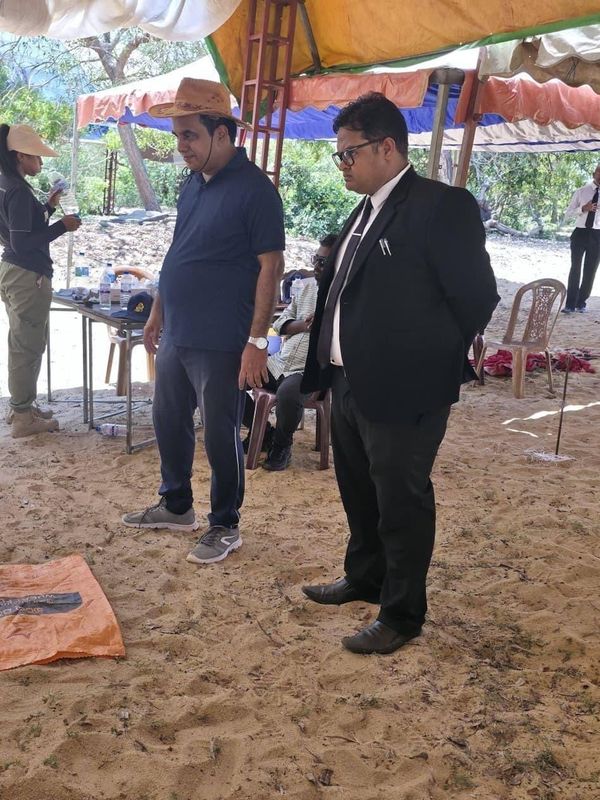
The court-ordered excavation is underway at Kurukkalmadam, in the Kaluwanchikudy police division of Batticaloa district, under the supervision of a magistrate and with forensic specialists present.

For families of the missing, the excavation marks a long-delayed step toward answers after years of uncertainty.

According to testimony presented before multiple government-appointed commissions, the victims were traveling along the Kalmunai–Batticaloa road on July 12, 1990, when they were stopped and abducted by cadres of the Liberation Tigers of Tamil Eelam (LTTE). Among them were Muslim pilgrims returning from Mecca after completing the Hajj.

They were later killed, and their bodies are believed to have been buried at or near the Kurukkalmadam site.

The killings took place during one of the most violent phases of Sri Lanka’s civil war, as the LTTE escalated attacks against Muslim communities in the north and east.

The period was also marked by retaliatory violence and deepening inter-communal tensions, with Tamil civilians in some areas targeted by Muslim home guards and armed groups aligned with the military. In widely cited incidents, Tamil civilians were killed in the eastern district of Batticaloa amid cycles of reprisal violence in the early 1990s.

Relatives of the victims have spent decades seeking the recovery of remains to allow for proper Islamic burial rites, as well as official acknowledgment of what occurred.

“What they want is to bury their dead with dignity,” said a legal advocate working with victims’ families. “That is the most basic form of closure.”

Officials said any human remains and physical evidence recovered during the excavation would be systematically documented and preserved as part of an ongoing forensic investigation. They declined to estimate how many bodies might be found.

Preliminary clearing of the site began a day earlier, with full excavation operations commencing on Sunday. Authorities said the process would proceed methodically under judicial oversight.

Sri Lanka has struggled to address the legacy of its 26-year civil war, which ended in 2009 with the military defeat of the LTTE. Efforts to investigate wartime abuses have repeatedly stalled, while institutions established to address enforced disappearances have faced sustained criticism from victims’ groups over limited progress.


Share this post

Be the first to know

Join our community and get notified about upcoming stories

Subscribing...
You've been subscribed!
Something went wrong
Colombo Eyes Control of Jaffna’s Cultural Centre

Colombo Eyes Control of Jaffna’s Cultural Centre

JAFFNA, Sri Lanka — Sri Lanka’s Cabinet is expected to consider a proposal to place the Jaffna Thiruvalluvar Cultural Centre under a new seven-member governing body dominated by central government representatives, according to officials familiar with the plan. If approved, the move would formalize national oversight of a complex built with Indian grant funding on land owned by the Jaffna Municipal Council — and presented, repeatedly, as a gift to the people of the North. The proposal has not b


Our Reporter

Our Reporter

Accountability for Others, Immunity for One’s Own

Accountability for Others, Immunity for One’s Own

On March 27, Kumara Jayakody walked into the Colombo High Court, was formally indicted on corruption charges, posted bail, and had his fingerprints taken. Then he returned to his ministerial office. On April 10, 153 Members of Parliament from the National People's Power voted to keep him there. He remains Sri Lanka's Energy Minister today — attending Cabinet, drawing a public salary, governing a portfolio that just lost seven billion rupees of public money. If this had happened under Mahinda Ra


Kaniyan Pungundran

Kaniyan Pungundran

The Tamil Renaissance

The Tamil Renaissance

By Jeevan Thiyagaraja Generations have scattered across the globe while others remained, tending to the soil of their ancestors through the unimaginable. Though separated by oceans and time, all share the same roots. The time has come for the North to reclaim its narrative—a Tamil Renaissance where a smart, confident, and contented North acts as catalyst for a proud, cultured, and developed community found around the world. I. The Ancient Maritime Spirit: A Legacy of Global Connection Long b


Jeevan Thiyagaraja

Jeevan Thiyagaraja

Iluppai Tree and the Young Generation

Iluppai Tree and the Young Generation

Translated from the original Tamil short story iluppai maramum iḷanñcantatiyum (இலுப்பை மரமும் இளஞ்சந்ததியும்) from the 1976 collection of short stories titled kōṭukaḷum kōlaṅkalum (கோடுகளும் கோலங்களும்) by Kuppilan Ai. Shanmugan. He woke up at around seven in the morning, when it was already rather bright. His little sister shook him awake, calling out, “aṇṇai, aṇṇai.” He stretched lazily, rolled up the reed mat and stood it next to the wall. The house was buzzing with activity. His sibling


Eḻuttukkiṉiyavaṉ

Eḻuttukkiṉiyavaṉ