
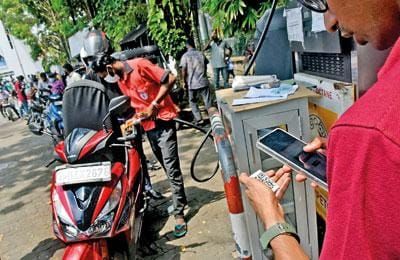
COLOMBO — March 15 — The government on Sunday reinstated the National Fuel Pass (QR code) system, requiring motorists to present a registered QR code in order to obtain fuel at filling stations, as authorities move to regulate distribution and maintain supply stability.
The Ministry of Power and Energy said the measure came into effect at 6:00 a.m. on March 15, and that fuel will not be issued at any station without a valid QR code linked to a registered vehicle.
The system, first introduced during the island nation’s severe 2022 economic and fuel crisis, allows authorities to allocate fixed weekly fuel quotas to each vehicle category, reducing long queues and preventing hoarding or irregular distribution.
Under the revised allocation announced by officials, motorcycles are entitled to 5 liters per week, while cars receive 15 liters and three-wheelers 15 liters. Vans are allocated 40 liters, buses 60 liters, and motor lorries up to 200 liters weekly.
Other categories include 25 liters for land vehicles such as jeeps, 40 liters for special-purpose vehicles, and 5 liters for quadricycles, according to the government’s distribution plan.
Registration Required Through Official Portal
Motorists must register their vehicles on the official government portal, fuelpass.gov.lk, to obtain the QR code required to purchase fuel. After completing the online registration process, users are issued a unique QR code linked to the vehicle’s registration details, which can be stored on a mobile phone or printed and presented at fuel stations.
At the pump, station staff scan the QR code to verify the vehicle’s identity and confirm the remaining fuel allocation for the week before dispensing fuel.
Vehicle owners who had previously registered under the earlier Fuel Pass program may download their existing QR codes directly through the portal if their registration details remain unchanged. However, newly registered vehicles and users who have not previously enrolled must complete the registration process starting from Saturday morning, officials said.
Authorities also cautioned that the website may experience heavy traffic following the announcement, and users encountering a “server busy” message are advised to attempt registration later.
However, as of 8:25 a.m. Sunday, when this report was filed, the rollout of the system appeared incomplete. Motorists attempting to register new vehicles on the official Fuel Pass portal were met with a message stating: “Registration to Fuel Pass has not started yet. It will be available soon.”
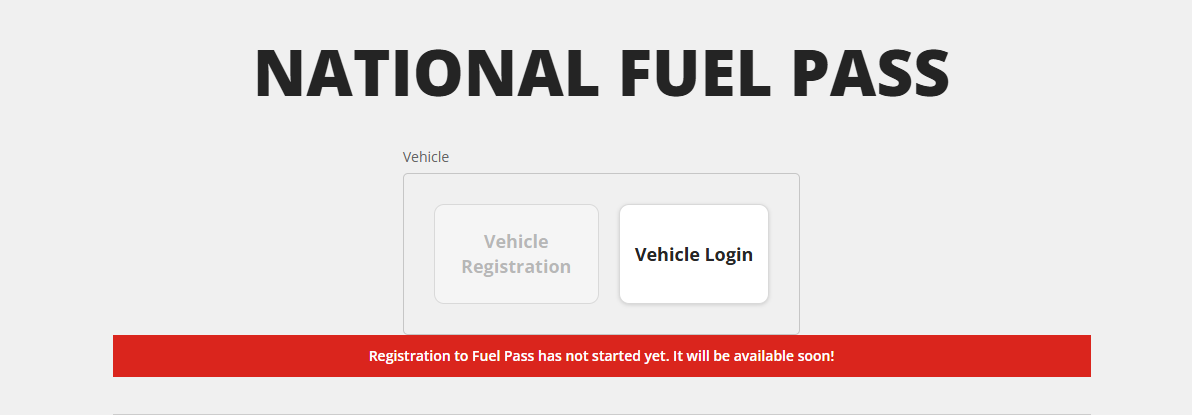
The notice means that only motorists who had previously registered under the earlier Fuel Pass system are currently able to access or download their QR codes, while owners of newly registered vehicles remain unable to enroll in the program.
The issue is particularly significant because Sri Lanka recently relaxed restrictions on vehicle imports, leading to the arrival of thousands of newly imported vehicles in the country. Many of these vehicles do not yet have a Fuel Pass registration.
As a result, owners of such vehicles currently have no immediate way to obtain the QR code required to purchase fuel, raising concerns about how they will access fuel under the reinstated system.
The situation could also affect motorists who are already traveling, as vehicles without an existing Fuel Pass registration may face difficulties obtaining fuel at filling stations, as the QR code requirement has been enforced since 6:00 a.m. Sunday.
Essential Services to Receive Priority Allocation
Officials said vehicles engaged in essential services, production activities, and other critical sectors would receive fuel under a special distribution program coordinated with relevant government institutions.
Fuel for private passenger transport buses will be distributed through the Sri Lanka Transport Board (SLTB) to ensure continuity of public transport services.
Legacy of the 2022 Crisis
The National Fuel Pass system was first introduced in July 2022, when Sri Lanka faced one of the worst economic crises in its history, marked by severe shortages of fuel, medicine, and foreign exchange. The digital system was designed to allocate fuel fairly and eliminate massive queues that once stretched for kilometers outside filling stations.
Officials say the technology-driven quota system helped stabilize distribution by linking each vehicle to a verifiable fuel allowance, enabling authorities to monitor consumption and manage limited supplies.
The return of tighter fuel controls comes against the backdrop of renewed turbulence in global energy markets following the recent conflict involving the United States, Israel, and Iran. In the aftermath of the fighting, shipping through the Strait of Hormuz — the narrow waterway linking the Persian Gulf to the Gulf of Oman and a corridor through which roughly one-fifth of the world’s oil supply normally flows — was significantly disrupted after Iran effectively restricted passage for many vessels.
The disruption pushed global oil prices upward and complicated fuel supplies for a number of import-dependent economies, including Sri Lanka.
Amid these pressures, Sri Lanka recently raised domestic fuel prices and has been exploring alternative supply arrangements. Officials have also held discussions with Russia’s ambassador in Colombo regarding the possibility of securing fuel through additional channels as the government seeks to stabilize supply and shield the country from further shocks in global energy markets.