

Sumanthiran Invites Former LTTE Combatants, Citing ‘Highest Qualification’

Sumanthiran Invites Former LTTE Combatants, Citing ‘Highest Qualification’


Share this post

KILINOCHCHI, Sri Lanka — March 30, 2026 —

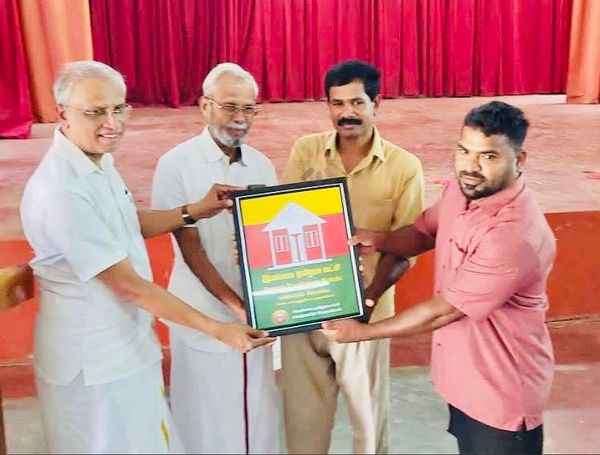
M. A. Sumanthiran, general secretary of the Ilankai Tamil Arasu Kachchi (ITAK), said on Sunday that former combatants who had sacrificed their lives, education, and families for a political cause were the most qualified to join the party.

Speaking at a meeting with former LTTE combatants in Kilinochchi, Mr. Sumanthiran said those who had “considered their lives insignificant” and were prepared to give their “life, body and soul” for a goal possessed the highest qualification for membership.

“No one else can have a greater qualification than them,” he said.

The event was attended by senior party figures, including ITAK leader C. V. K. Sivagnanam and Sayanthan.

Framing his remarks within the party’s historical ideology, Mr. Sumanthiran said ITAK, founded in 1949, was built on the premise that Tamil-speaking people in Sri Lanka constitute a distinct nation entitled to self-determination under international law.

He drew parallels with independence movements elsewhere, noting that leaders such as Muhammad Ali Jinnah of Pakistan and Sheikh Mujibur Rahman are remembered as “Fathers of the Nation” for articulating a shared national identity.

He then extended that comparison to S. J. V. Chelvanayakam, explaining that he came to be known as “Thanthai” (Father) for advancing the idea that Tamil-speaking people in Sri Lanka are a distinct nation with a right to self-determination.

Mr. Sumanthiran also referred to recent discussions in New Delhi, where he and colleagues attended meetings at the invitation of the Bar Association of India. He cited concerns about Sri Lankan Tamil refugees who have lived in India for decades.

While reiterating that his party preferred the return of displaced Tamils to Sri Lanka, he said those unwilling to return — due to age, family circumstances, or long-term settlement — should be granted Indian citizenship to avoid statelessness.

“International law does not permit people to remain stateless,” he said.

He also recalled that the ITAK emerged in opposition to the 1949 citizenship legislation that rendered large numbers of Malayaga Tamils stateless, and said it was the first political movement to assert that Tamils constitute a nation with the right to self-determination.

Referring to the Vaddukoddai Resolution, he said the party had formally articulated its demand for self-rule decades ago.

“Forms of struggle may change, but the goal remains the same,” he said, adding that former combatants had every right to join the party in pursuit of that goal.

Still, sources within ITAK offered a more grounded view. “Yes, the invitation is there,” one told the Jaffna Monitor. “But if you’re not a ‘yes man’ to Sumanthiran, how exactly do you get a ticket?”


Share this post

Be the first to know

Join our community and get notified about upcoming stories

Subscribing...
You've been subscribed!
Something went wrong
Colombo Eyes Control of Jaffna’s Cultural Centre

Colombo Eyes Control of Jaffna’s Cultural Centre

JAFFNA, Sri Lanka — Sri Lanka’s Cabinet is expected to consider a proposal to place the Jaffna Thiruvalluvar Cultural Centre under a new seven-member governing body dominated by central government representatives, according to officials familiar with the plan. If approved, the move would formalize national oversight of a complex built with Indian grant funding on land owned by the Jaffna Municipal Council — and presented, repeatedly, as a gift to the people of the North. The proposal has not b


Our Reporter

Our Reporter

Accountability for Others, Immunity for One’s Own

Accountability for Others, Immunity for One’s Own

On March 27, Kumara Jayakody walked into the Colombo High Court, was formally indicted on corruption charges, posted bail, and had his fingerprints taken. Then he returned to his ministerial office. On April 10, 153 Members of Parliament from the National People's Power voted to keep him there. He remains Sri Lanka's Energy Minister today — attending Cabinet, drawing a public salary, governing a portfolio that just lost seven billion rupees of public money. If this had happened under Mahinda Ra


Kaniyan Pungundran

Kaniyan Pungundran

The Tamil Renaissance

The Tamil Renaissance

By Jeevan Thiyagaraja Generations have scattered across the globe while others remained, tending to the soil of their ancestors through the unimaginable. Though separated by oceans and time, all share the same roots. The time has come for the North to reclaim its narrative—a Tamil Renaissance where a smart, confident, and contented North acts as catalyst for a proud, cultured, and developed community found around the world. I. The Ancient Maritime Spirit: A Legacy of Global Connection Long b


Jeevan Thiyagaraja

Jeevan Thiyagaraja

Iluppai Tree and the Young Generation

Iluppai Tree and the Young Generation

Translated from the original Tamil short story iluppai maramum iḷanñcantatiyum (இலுப்பை மரமும் இளஞ்சந்ததியும்) from the 1976 collection of short stories titled kōṭukaḷum kōlaṅkalum (கோடுகளும் கோலங்களும்) by Kuppilan Ai. Shanmugan. He woke up at around seven in the morning, when it was already rather bright. His little sister shook him awake, calling out, “aṇṇai, aṇṇai.” He stretched lazily, rolled up the reed mat and stood it next to the wall. The house was buzzing with activity. His sibling


Eḻuttukkiṉiyavaṉ

Eḻuttukkiṉiyavaṉ