

U.N. Envoy Urges Sri Lanka to Resolve Northern Land Disputes

U.N. Envoy Urges Sri Lanka to Resolve Northern Land Disputes


Share this post

JAFFNA, Sri Lanka — March 26, 2026 — The United Nations’ top representative in Sri Lanka on Thursday called for urgent action to resolve long-standing land disputes in the country’s north, after meeting farmers who have been barred from accessing their lands for nearly a decade despite holding legal title.

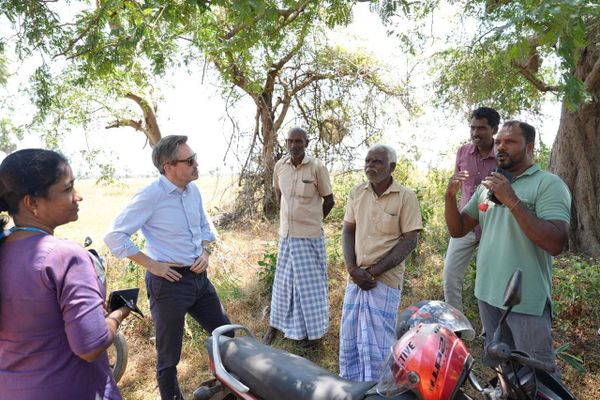
Marc-André Franche, the U.N. Resident Coordinator and representative of the Secretary-General in Sri Lanka, visited Kovilvayal, a village in the Kilinochchi district, where he met with affected families and surveyed lands that residents say have remained inaccessible since 2015 due to state designations linked to forestry and wildlife protection.

In a statement posted on social media following the visit, Mr. Franche said that around 1,420 acres — including paddy fields, private lands, and cemeteries — had been out of reach for local communities.

“Resolving these land issues … is not only an issue of fairness, but of development, growth and poverty reduction,” he said, adding that landowners must be involved in decision-making processes and, at a minimum, compensated.

The remarks come as land ownership disputes continue to simmer in Sri Lanka’s Northern and Eastern Provinces, where Tamil communities have long complained of losing access to ancestral lands after parts were brought under state control or reclassified for conservation purposes in the years following the end of the civil war in 2009.
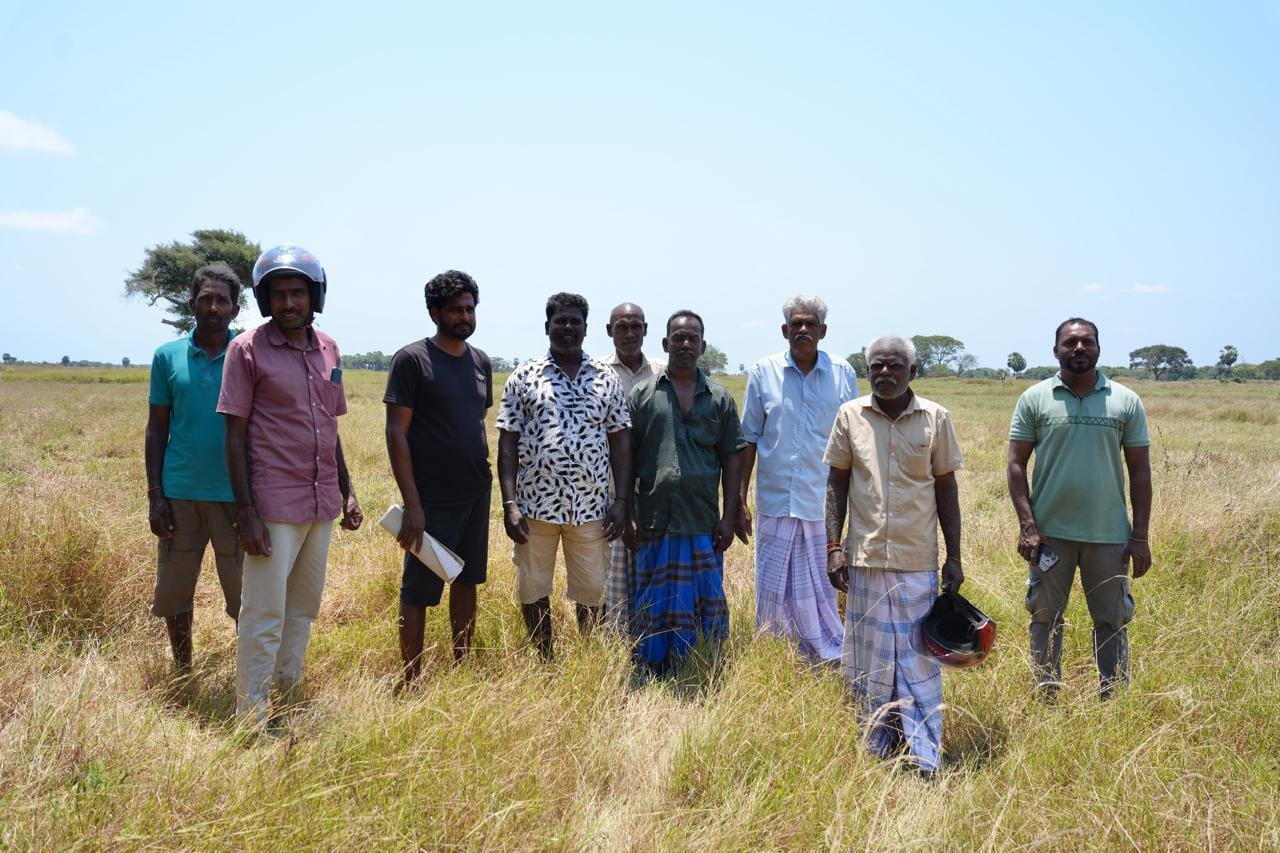
Farmers in Kovilvayal, Kilinochchi, whose lands have remained inaccessible since 2015 despite holding legal title.

Farmers who met Mr. Franche described deepening economic hardship, saying that their inability to cultivate their land had eroded household incomes and increased their dependence on irregular work. Some also raised concerns over restricted access to burial grounds, underscoring the cultural and emotional dimensions of the dispute.

Sri Lankan officials have previously defended such land classifications as necessary for environmental conservation, particularly in ecologically sensitive zones. However, rights groups and local activists argue that the process has often lacked transparency and adequate consultation, leaving communities in prolonged uncertainty.

Political observers said Mr. Franche’s intervention was likely to intensify scrutiny of the government’s handling of land disputes in the north, an issue that has remained politically sensitive years after the end of the civil war.

But some affected residents expressed caution about the impact of such high-profile visits. One farmer who spoke to Jaffna Monitor said that raising the issue once would not be enough to bring meaningful change.

“Just highlighting this at one point will be seen as symbolic rather than a serious intervention,” he said. “What is needed is sustained engagement — continuous pressure on the government — not a one-time visit or a photo opportunity.”

No immediate response was available from Sri Lankan authorities regarding the envoy’s remarks, and it remained unclear whether the government would engage further following the envoy’s visit.


Share this post

Be the first to know

Join our community and get notified about upcoming stories

Subscribing...
You've been subscribed!
Something went wrong
Colombo Eyes Control of Jaffna’s Cultural Centre

Colombo Eyes Control of Jaffna’s Cultural Centre

JAFFNA, Sri Lanka — Sri Lanka’s Cabinet is expected to consider a proposal to place the Jaffna Thiruvalluvar Cultural Centre under a new seven-member governing body dominated by central government representatives, according to officials familiar with the plan. If approved, the move would formalize national oversight of a complex built with Indian grant funding on land owned by the Jaffna Municipal Council — and presented, repeatedly, as a gift to the people of the North. The proposal has not b


Our Reporter

Our Reporter

Accountability for Others, Immunity for One’s Own

Accountability for Others, Immunity for One’s Own

On March 27, Kumara Jayakody walked into the Colombo High Court, was formally indicted on corruption charges, posted bail, and had his fingerprints taken. Then he returned to his ministerial office. On April 10, 153 Members of Parliament from the National People's Power voted to keep him there. He remains Sri Lanka's Energy Minister today — attending Cabinet, drawing a public salary, governing a portfolio that just lost seven billion rupees of public money. If this had happened under Mahinda Ra


Kaniyan Pungundran

Kaniyan Pungundran

The Tamil Renaissance

The Tamil Renaissance

By Jeevan Thiyagaraja Generations have scattered across the globe while others remained, tending to the soil of their ancestors through the unimaginable. Though separated by oceans and time, all share the same roots. The time has come for the North to reclaim its narrative—a Tamil Renaissance where a smart, confident, and contented North acts as catalyst for a proud, cultured, and developed community found around the world. I. The Ancient Maritime Spirit: A Legacy of Global Connection Long b


Jeevan Thiyagaraja

Jeevan Thiyagaraja

Iluppai Tree and the Young Generation

Iluppai Tree and the Young Generation

Translated from the original Tamil short story iluppai maramum iḷanñcantatiyum (இலுப்பை மரமும் இளஞ்சந்ததியும்) from the 1976 collection of short stories titled kōṭukaḷum kōlaṅkalum (கோடுகளும் கோலங்களும்) by Kuppilan Ai. Shanmugan. He woke up at around seven in the morning, when it was already rather bright. His little sister shook him awake, calling out, “aṇṇai, aṇṇai.” He stretched lazily, rolled up the reed mat and stood it next to the wall. The house was buzzing with activity. His sibling


Eḻuttukkiṉiyavaṉ

Eḻuttukkiṉiyavaṉ